
Artificial intelligence has created one of the most profound challenges facing higher education. If students can submit polished essays or other written assignments that were AI-generated in seconds, what do those submissions tell us about what they learned?
For many faculty members, that question has become a source of frustration — even alarm. For Dr. Danny Walker, chair of Philosophy and Arts at Wilmington University’s College of Education and Liberal Arts, it became the beginning of an unexpected journey.
Dr. Walker discovered that he and other educators were asking the wrong questions. Instead of trying to catch and prevent students from using AI, could they redesign learning so that AI requires students to engage and think more deeply while using it? That journey led to the creation of Willo, an AI learning assistant now running in multiple courses across Wilmington University. In this interview, Dr. Walker talks about how his own thinking evolved into the creation of Willo and why he believes the future of education depends more on redesigning learning than resisting technology.
Many may assume you embraced AI immediately because of the work you’re doing now. Was that actually the case?
Not at all. My first reaction was probably the same as many professors. I was worried. When generative AI first became available, I spent months reading about the potential negative impacts of AI misuse in higher education and observed many of those challenges firsthand in the online courses I teach, which represent the predominant instructional model
at Wilmington University and in my department.
I immediately began experimenting with AI detection software like Turnitin, looking for ways to preserve the academic integrity of assignments I had trusted for years. Looking back, I realized I was trying to save a system that was no longer able to provide the evidence of learning that I felt was needed to accurately assess student work. I ultimately realized I was asking the wrong questions. Instead of asking, “How do we catch students using AI?” or “How do we adapt AI to our existing assignments?” I should have been asking, “How do we redesign learning so that AI helps students think instead of enabling them to avoid thinking?” In simple terms, “How do we effectively educate students in an AI world?”
That may seem obvious to you now, but probably not at the time?
It wasn’t. It required admitting that some of my own assumptions about teaching were no longer valid. In the past, a well-written paper was considered reliable evidence of learning. Because AI can now produce polished writing with little or no intellectual effort from students, I realized that the quality of the final paper can no longer be relied on as evidence of genuine thinking.
Once I grasped that, I was able to refocus on what really mattered: engaging and challenging students to think for themselves in ways that confirm their reasoning process. I’m convinced that if we as educators don’t adjust to this new reality, we run the risk of graduating most students who cruised through their academic journey on autopilot, many
receiving high scores but never learning to think critically or creatively or to experience the struggle required to develop the competencies that higher education should instill.
If traditional assignments no longer provide reliable evidence of learning, what do instructors do?
At first, I thought the answer was simply better feedback. As I began experimenting with generative AI, despite its early limitations, I was impressed with its ability to communicate conversationally with students and provide detailed analysis and feedback. The first project I created was an AI feedback assistant for Intro to Critical Thinking (PHI 100). I loaded a custom AI with course content, directions, and a rubric and prompted it to provide feedback for improvement. Students completed a draft and then received immediate coaching from the assistant, with opportunities to revise their work before submitting it to the instructor. The results were encouraging. Students revised more, reflected more, and overwhelmingly valued receiving feedback while the assignment was still fresh in their minds. We successfully piloted this approach with more than 800 students for about a year.
Was there something that still wasn’t quite right?
Yes. As students became more adept at using AI, we were faced increasingly with the question of whether their first drafts were their own authentic writing. The problem was that students could still ask AI to write the first drafts before bringing them to the feedback assistant. The feedback was excellent, but the learning might already have been outsourced. Our only strategy for dealing with this involved the use of AI detection software, like Turnitin. However, because these tools hadn’t proven to be reliable enough for us to be confident about their results, instructors ended up spending more time playing AI detectives than teachers.
That realization convinced me that AI really wasn’t the core problem —and AI isn’t going away. In fact, it’s rapidly improving, and usage among students is increasing. The real problem now is that our assessments aren’t designed for this new AI world. So, I ultimately changed my direction. Rather than trying to force AI into traditional assignments, I decided to use AI’s strengths to redesign our approach to learning.

Is that what led to the creation of Willo?
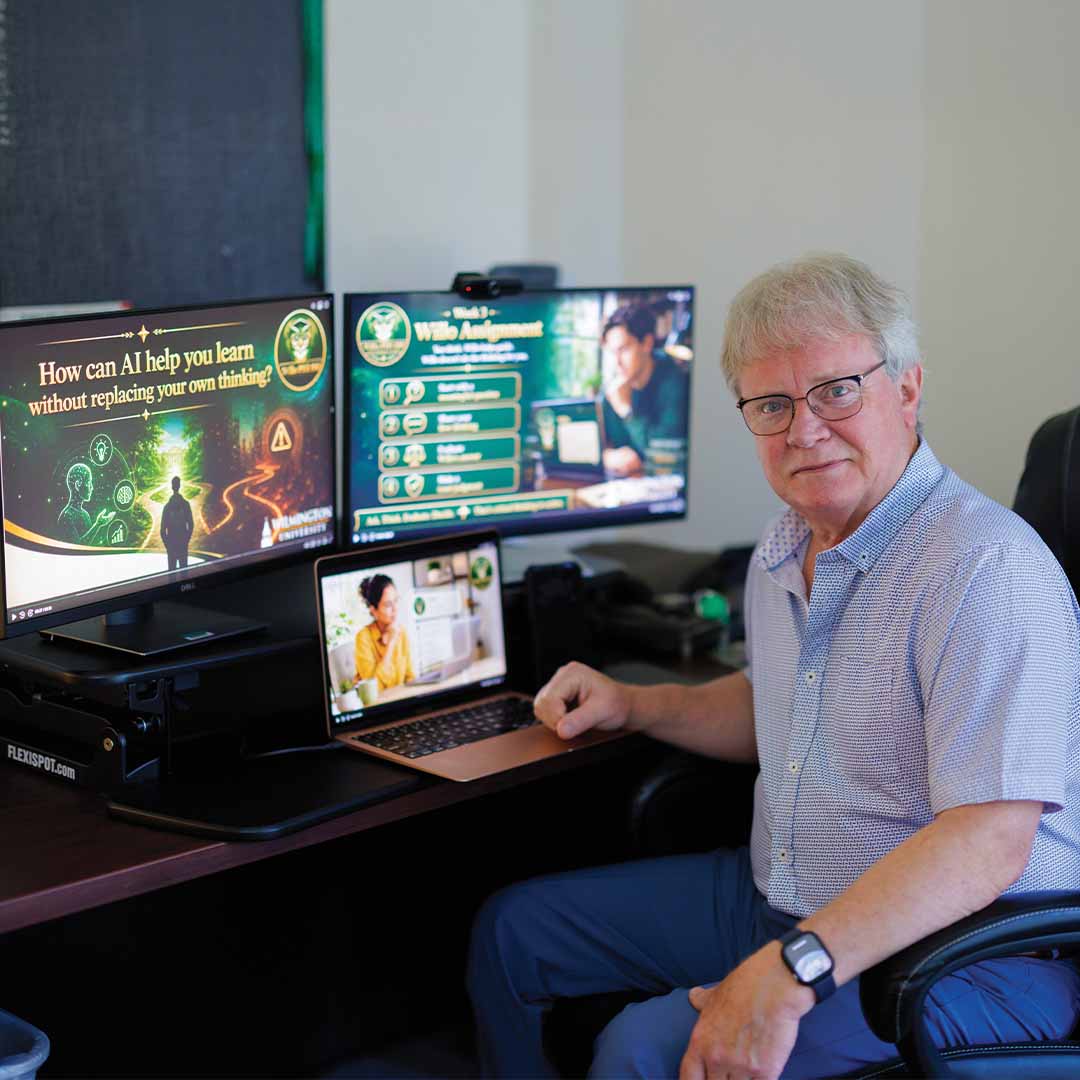
Yes. Willo is a secure, web-based AI-guided learning assistant that students log into through a university website while completing course assignments. Think of it as having a patient tutor sitting beside every student as they work. Unlike most AI tools, which are designed primarily to provide answers, Willo is designed primarily to ask questions. Students carry on an ongoing conversation with Willo as they complete an assignment. It coaches rather than answers, challenges assumptions, provides feedback, encourages revision, and prompts students to explain and defend their reasoning. The goal isn’t to prevent them from using AI; it’s to ensure that they are still doing the intellectual work that leads to genuine learning.
Where did the name come from?
A colleague suggested that a name would help students relate to it, so we did some brainstorming. “Willo” seemed like a natural fit because of its connection to WilmU, and since the goal is to encourage thoughtful reasoning, a wise owl felt like the perfect mascot. After all, our Athletics mascot is Wiley the Wildcat. It only seemed fair that academics should have Willo the Wilosopher. (Note: Academic Affairs is now collaborating with colleagues to develop Willo’s brand identity and consider longer-term trademark opportunities.)
What makes Willo different? If you’re no longer relying primarily on the finished paper for grading, what evidence does Willo help students provide that instructors can assess?
That became one of the most important design questions. If students are going to use AI, instructors need a way to observe the thinking that happens along the way, not just the polished results at the end. That’s where the chat history comes in.
Every conversation students have with Willo is automatically saved as a chronological record of their learning process. Think of it as a transcript of their intellectual journey. Instructors can see the student’s initial ideas, the questions Willo asked, how the student responded, where they struggled, how their reasoning evolved, and what changes they made before submitting the assignment.
Just as important, Willo continually evaluates the student’s work against the assignment rubric. As students complete each section, Willo provides a suggested score for every rubric criterion, explains why they earned that score, and offers specific suggestions for improvement. Students can immediately see where they are doing well and where their
reasoning needs to be strengthened. As they revise, they can watch those scores improve in real time.
So, students aren’t just getting answers. They’re getting continuous coaching while instructors view the entire learning process.
Right. Instead of guessing whether a well-written paper reflects genuine learning, instructors have access to a transparent record of how students developed their ideas. The final assignment still matters, but now it’s accompanied by evidence showing how students questioned assumptions, responded to feedback, revised their thinking, and ultimately arrived at their conclusions. That’s a much richer picture of learning than a final paper alone can provide.
Can you give readers an example of what that coaching looks like?
I remember one student in my Critical Thinking class who revised the same assignment multiple times because Willo kept asking for clearer reasoning instead of accepting the first answer they gave that was, perhaps, a bit superficial. It challenged the student’s assumptions, asked for evidence required by the rubric, and invited the student to consider competing viewpoints. By the end of the conversation, the submission was much stronger, and the student’s thinking was much deeper.
Also, we have learned that students value not just the quality but the immediate feedback. They literally have a coach providing tutorial analysis and advice 24/7. I often picture a Wilmington student finally sitting down at 10:30 on a Saturday night. With Willo, the student receives instant guidance on assignments. The instructor may not be available in the moment, but Willo is there, and learning doesn’t stop.
Some readers will still wonder whether AI will inevitably become another shortcut that makes learning easier rather than deeper.
That’s a fair concern. Throughout history, new educational technologies, from calculators to word processors to the
internet, have reduced some of the work students once had to do. But the more important question is whether they also reduce students’ thinking.
More than 2,000 years ago, Socrates was skeptical of writing because he feared it would replace the kind of dialogue he believed was essential to learning. Ironically, AI now allows us to bring that dialogue back to the center of education. However, Willo must be intentionally structured that way. Properly designed, Willo doesn’t simply provide answers. If a student’s reasoning is weak, it asks another question. If there’s a logical gap, it doesn’t fill it in. It challenges the student to examine the gap, defend a position, reconsider assumptions, and refine their thinking before moving on. The goal isn’t efficiency. The goal is to keep students intellectually engaged in the work of thinking.
If AI can coach students around the clock, help them think better, and provide a rubric-based score, where does that leave instructors? Is AI eventually going to replace them?
I don’t think so. In fact, I believe that in today’s world, AI makes good instructors even more important. Teaching has never really been about just delivering information. Since the advent of the internet, finding information is no longer an issue. The real value of a professor is helping students develop judgment, ask better questions, recognize weak reasoning, encourage curiosity, and create learning experiences that challenge them to grow.
Willo was never designed to replace instructors; it was designed to extend their reach. Think of it as a teaching assistant that’s available whenever the instructor can’t be. It can provide immediate coaching outside the classroom, but it can’t replace the insight, mentorship, and judgment that engaged instructors bring to the learning process. True, routine tasks like grammar checking or following assignment directions will become easier to automate, but teachers still retain control over the final grade. Also, they have more opportunity to spend time doing the things that matter most: mentoring students, designing meaningful learning experiences, facilitating discussions, and helping students develop wisdom, not just knowledge. In my experience of using and closely observing Willo’s use by other instructors, it can deepen an instructor’s role in supporting student learning.
How has the project evolved from a classroom pilot into a broader initiative?
One of the most rewarding parts of this work has been seeing it grow beyond a single course. As the pilot produced encouraging results, I had opportunities to share its progress, refinements, and outcomes through Academic Council, Faculty Senate, and Teaching Excellence Day. Those conversations helped build broader interest and support across
Academic Affairs.
Academic Council has since aligned Willo with the University’s strategic priorities related to student engagement and retention. Working with Educational Effectiveness, we identified High Touch courses as the next priority for expansion.
At the same time, we want to grow carefully. Before Willo is opened to faculty more broadly, we need to continue refining how its effectiveness is evaluated within the course. Responsible expansion will also require close collaboration with Information Technology, Online Learning and the Center for Teaching Excellence so faculty have the education, development and support they need.
The goal is purposeful growth. We want to build a strong framework that allows Willo to expand across colleges in a way that supports student learning and success.
Where do you think it goes from here?
I don’t believe the future belongs to educators who try to pretend AI doesn’t exist or hope they can somehow ban it from higher education. But I also don’t believe it belongs to those who simply surrender to it by looking the other way or allowing AI to do the intellectual heavy lifting for students. Both approaches miss the real opportunity.
The future belongs to educators who are willing to rethink how learning happens. Our challenge isn’t to compete with AI or to be afraid of it, but to design learning experiences where AI can become a catalyst for curiosity, reflection, revision, and deeper reasoning rather than a substitute for thinking. If we do that well, students won’t just complete course content. They’ll develop the habits of mindful critical thinking, sound judgment, creativity, and intellectual resilience that will serve them long after today’s AI tools have been replaced.
AI may change the tools we use, but it doesn’t change our mission. Our responsibility has always been to help students learn how to think, not simply what to produce. If anything, in an increasingly AI-driven world, that mission has become even more essential.

Want to read more in-depth stories? Explore our latest magazine articles.
Artificial intelligence has created one of the most profound challenges facing higher education. If students can submit polished essays or other written assignments that were AI-generated in seconds, what do those submissions tell us about what they learned?
For many faculty members, that question has become a source of frustration — even alarm. For Dr. Danny Walker, chair of Philosophy and Arts at Wilmington University’s College of Education and Liberal Arts, it became the beginning of an unexpected journey.
Dr. Walker discovered that he and other educators were asking the wrong questions. Instead of trying to catch and prevent students from using AI, could they redesign learning so that AI requires students to engage and think more deeply while using it? That journey led to the creation of Willo, an AI learning assistant now running in multiple courses across Wilmington University. In this interview, Dr. Walker talks about how his own thinking evolved into the creation of Willo and why he believes the future of education depends more on redesigning learning than resisting technology.
Many may assume you embraced AI immediately because of the work you’re doing now. Was that actually the case?
Not at all. My first reaction was probably the same as many professors. I was worried. When generative AI first became available, I spent months reading about the potential negative impacts of AI misuse in higher education and observed many of those challenges firsthand in the online courses I teach, which represent the predominant instructional model
at Wilmington University and in my department.
I immediately began experimenting with AI detection software like Turnitin, looking for ways to preserve the academic integrity of assignments I had trusted for years. Looking back, I realized I was trying to save a system that was no longer able to provide the evidence of learning that I felt was needed to accurately assess student work. I ultimately realized I was asking the wrong questions. Instead of asking, “How do we catch students using AI?” or “How do we adapt AI to our existing assignments?” I should have been asking, “How do we redesign learning so that AI helps students think instead of enabling them to avoid thinking?” In simple terms, “How do we effectively educate students in an AI world?”
That may seem obvious to you now, but probably not at the time?
It wasn’t. It required admitting that some of my own assumptions about teaching were no longer valid. In the past, a well-written paper was considered reliable evidence of learning. Because AI can now produce polished writing with little or no intellectual effort from students, I realized that the quality of the final paper can no longer be relied on as evidence of genuine thinking.
Once I grasped that, I was able to refocus on what really mattered: engaging and challenging students to think for themselves in ways that confirm their reasoning process. I’m convinced that if we as educators don’t adjust to this new reality, we run the risk of graduating most students who cruised through their academic journey on autopilot, many
receiving high scores but never learning to think critically or creatively or to experience the struggle required to develop the competencies that higher education should instill.
If traditional assignments no longer provide reliable evidence of learning, what do instructors do?
At first, I thought the answer was simply better feedback. As I began experimenting with generative AI, despite its early limitations, I was impressed with its ability to communicate conversationally with students and provide detailed analysis and feedback. The first project I created was an AI feedback assistant for Intro to Critical Thinking (PHI 100). I loaded a custom AI with course content, directions, and a rubric and prompted it to provide feedback for improvement. Students completed a draft and then received immediate coaching from the assistant, with opportunities to revise their work before submitting it to the instructor. The results were encouraging. Students revised more, reflected more, and overwhelmingly valued receiving feedback while the assignment was still fresh in their minds. We successfully piloted this approach with more than 800 students for about a year.
Was there something that still wasn’t quite right?
Yes. As students became more adept at using AI, we were faced increasingly with the question of whether their first drafts were their own authentic writing. The problem was that students could still ask AI to write the first drafts before bringing them to the feedback assistant. The feedback was excellent, but the learning might already have been outsourced. Our only strategy for dealing with this involved the use of AI detection software, like Turnitin. However, because these tools hadn’t proven to be reliable enough for us to be confident about their results, instructors ended up spending more time playing AI detectives than teachers.
That realization convinced me that AI really wasn’t the core problem —and AI isn’t going away. In fact, it’s rapidly improving, and usage among students is increasing. The real problem now is that our assessments aren’t designed for this new AI world. So, I ultimately changed my direction. Rather than trying to force AI into traditional assignments, I decided to use AI’s strengths to redesign our approach to learning.
Is that what led to the creation of Willo?
Yes. Willo is a secure, web-based AI-guided learning assistant that students log into through a university website while completing course assignments. Think of it as having a patient tutor sitting beside every student as they work. Unlike most AI tools, which are designed primarily to provide answers, Willo is designed primarily to ask questions. Students carry on an ongoing conversation with Willo as they complete an assignment. It coaches rather than answers, challenges assumptions, provides feedback, encourages revision, and prompts students to explain and defend their reasoning. The goal isn’t to prevent them from using AI; it’s to ensure that they are still doing the intellectual work that leads to genuine learning.
Where did the name come from?
A colleague suggested that a name would help students relate to it, so we did some brainstorming. “Willo” seemed like a natural fit because of its connection to WilmU, and since the goal is to encourage thoughtful reasoning, a wise owl felt like the perfect mascot. After all, our Athletics mascot is Wiley the Wildcat. It only seemed fair that academics should have Willo the Wilosopher. (Note: Academic Affairs is now collaborating with colleagues to develop Willo’s brand identity and consider longer-term trademark opportunities.)
What makes Willo different? If you’re no longer relying primarily on the finished paper for grading, what evidence does Willo help students provide that instructors can assess?
That became one of the most important design questions. If students are going to use AI, instructors need a way to observe the thinking that happens along the way, not just the polished results at the end. That’s where the chat history comes in.
Every conversation students have with Willo is automatically saved as a chronological record of their learning process. Think of it as a transcript of their intellectual journey. Instructors can see the student’s initial ideas, the questions Willo asked, how the student responded, where they struggled, how their reasoning evolved, and what changes they made before submitting the assignment.
Just as important, Willo continually evaluates the student’s work against the assignment rubric. As students complete each section, Willo provides a suggested score for every rubric criterion, explains why they earned that score, and offers specific suggestions for improvement. Students can immediately see where they are doing well and where their
reasoning needs to be strengthened. As they revise, they can watch those scores improve in real time.
So, students aren’t just getting answers. They’re getting continuous coaching while instructors view the entire learning process.
Right. Instead of guessing whether a well-written paper reflects genuine learning, instructors have access to a transparent record of how students developed their ideas. The final assignment still matters, but now it’s accompanied by evidence showing how students questioned assumptions, responded to feedback, revised their thinking, and ultimately arrived at their conclusions. That’s a much richer picture of learning than a final paper alone can provide.
Can you give readers an example of what that coaching looks like?
I remember one student in my Critical Thinking class who revised the same assignment multiple times because Willo kept asking for clearer reasoning instead of accepting the first answer they gave that was, perhaps, a bit superficial. It challenged the student’s assumptions, asked for evidence required by the rubric, and invited the student to consider competing viewpoints. By the end of the conversation, the submission was much stronger, and the student’s thinking was much deeper.
Also, we have learned that students value not just the quality but the immediate feedback. They literally have a coach providing tutorial analysis and advice 24/7. I often picture a Wilmington student finally sitting down at 10:30 on a Saturday night. With Willo, the student receives instant guidance on assignments. The instructor may not be available in the moment, but Willo is there, and learning doesn’t stop.
Some readers will still wonder whether AI will inevitably become another shortcut that makes learning easier rather than deeper.
That’s a fair concern. Throughout history, new educational technologies, from calculators to word processors to the
internet, have reduced some of the work students once had to do. But the more important question is whether they also reduce students’ thinking.
More than 2,000 years ago, Socrates was skeptical of writing because he feared it would replace the kind of dialogue he believed was essential to learning. Ironically, AI now allows us to bring that dialogue back to the center of education. However, Willo must be intentionally structured that way. Properly designed, Willo doesn’t simply provide answers. If a student’s reasoning is weak, it asks another question. If there’s a logical gap, it doesn’t fill it in. It challenges the student to examine the gap, defend a position, reconsider assumptions, and refine their thinking before moving on. The goal isn’t efficiency. The goal is to keep students intellectually engaged in the work of thinking.
If AI can coach students around the clock, help them think better, and provide a rubric-based score, where does that leave instructors? Is AI eventually going to replace them?
I don’t think so. In fact, I believe that in today’s world, AI makes good instructors even more important. Teaching has never really been about just delivering information. Since the advent of the internet, finding information is no longer an issue. The real value of a professor is helping students develop judgment, ask better questions, recognize weak reasoning, encourage curiosity, and create learning experiences that challenge them to grow.
Willo was never designed to replace instructors; it was designed to extend their reach. Think of it as a teaching assistant that’s available whenever the instructor can’t be. It can provide immediate coaching outside the classroom, but it can’t replace the insight, mentorship, and judgment that engaged instructors bring to the learning process. True, routine tasks like grammar checking or following assignment directions will become easier to automate, but teachers still retain control over the final grade. Also, they have more opportunity to spend time doing the things that matter most: mentoring students, designing meaningful learning experiences, facilitating discussions, and helping students develop wisdom, not just knowledge. In my experience of using and closely observing Willo’s use by other instructors, it can deepen an instructor’s role in supporting student learning.
How has the project evolved from a classroom pilot into a broader initiative?
One of the most rewarding parts of this work has been seeing it grow beyond a single course. As the pilot produced encouraging results, I had opportunities to share its progress, refinements, and outcomes through Academic Council, Faculty Senate, and Teaching Excellence Day. Those conversations helped build broader interest and support across
Academic Affairs.
Academic Council has since aligned Willo with the University’s strategic priorities related to student engagement and retention. Working with Educational Effectiveness, we identified High Touch courses as the next priority for expansion.
At the same time, we want to grow carefully. Before Willo is opened to faculty more broadly, we need to continue refining how its effectiveness is evaluated within the course. Responsible expansion will also require close collaboration with Information Technology, Online Learning and the Center for Teaching Excellence so faculty have the education, development and support they need.
The goal is purposeful growth. We want to build a strong framework that allows Willo to expand across colleges in a way that supports student learning and success.
Where do you think it goes from here?
I don’t believe the future belongs to educators who try to pretend AI doesn’t exist or hope they can somehow ban it from higher education. But I also don’t believe it belongs to those who simply surrender to it by looking the other way or allowing AI to do the intellectual heavy lifting for students. Both approaches miss the real opportunity.
The future belongs to educators who are willing to rethink how learning happens. Our challenge isn’t to compete with AI or to be afraid of it, but to design learning experiences where AI can become a catalyst for curiosity, reflection, revision, and deeper reasoning rather than a substitute for thinking. If we do that well, students won’t just complete course content. They’ll develop the habits of mindful critical thinking, sound judgment, creativity, and intellectual resilience that will serve them long after today’s AI tools have been replaced.
AI may change the tools we use, but it doesn’t change our mission. Our responsibility has always been to help students learn how to think, not simply what to produce. If anything, in an increasingly AI-driven world, that mission has become even more essential.
Want to read more in-depth stories? Explore our latest magazine articles.