
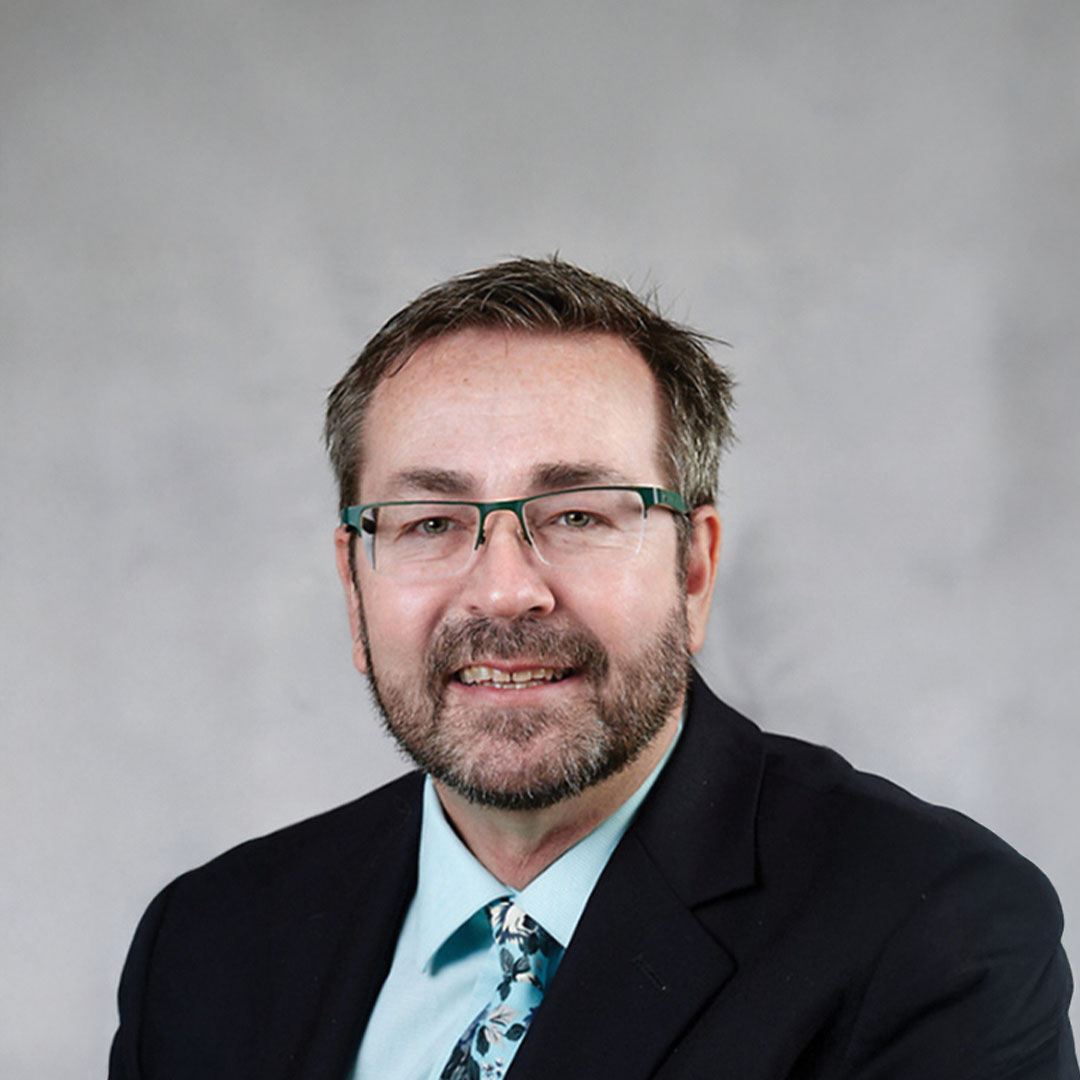
Growing up in Pennsville, which he describes as “Exit 1 off the New Jersey Turnpike,” Dr. Paul Clements admired his father, who was a chemist for DuPont. Young Paul also had an affinity for beakers and Bunsen burners, so following in his dad’s footsteps was a definite possibility.
Then, as a junior college student, he landed a job as a unit clerk in the ICU and emergency room of a South Jersey health system, and he saw nurses in action. When he rotated into the psychiatric unit, it shifted his career focus; nursing wasn’t just interesting — it felt like a calling.
Answering that call decades ago set him on a path that would eventually lead to some of the most difficult and emotionally demanding corners of forensic nursing.
Dr. Clements earned his associate degree in Nursing from Cumberland County College in Millville, New Jersey, in 1990, then immediately began looking for a bachelor’s program that would allow him to continue working. He chose then-Wilmington College and made the drive across the Delaware Memorial Bridge two nights a week for four-hour classes while working three 12-hour shifts each week at ChristianaCare in New Castle.
“I loved the curriculum,” Dr. Clements says. “It was robust and real-world. It was well worth the long drive.”
The surroundings were modest — classes met in trailers — but the program’s flexibility and rigor suited him, and Dr. Clements graduated in 1992 with the foundation for the rest of his professional life.
“WilmU’s BSN program was the basis of everything that followed in my nursing career,” he says. “The support, flexibility and real-world focus of the program not only gave me the confidence to pursue graduate studies at Penn but also shaped my identity as a nurse, scholar and educator.”
On a whim, he applied to the University of Pennsylvania for graduate school, got in, and completed his MSN, Child and Family Psychiatric Mental Health Nursing, in just 10 months. Emboldened by that success, he applied to Penn’s Ph.D. Nursing program. Out of 238 applicants, only 14 were selected. He was one of them.
For his dissertation, Dr. Clements interviewed children who had witnessed the homicide of a family member. The work demanded both clinical precision and emotional stamina, foreshadowing a professional life centered on helping people navigate the aftermath of trauma and violence.
As a forensic psychiatric nurse, he began working on cases involving murders, kidnappings and human trafficking. Over the decades, he has consulted with more than 2,000 families of murder victims. He has responded to crime scenes, advised hospital systems, guided emergency medical personnel and child protective agencies, and helped school systems respond to the violent deaths of students.
“I deal with hardcore situations,” Dr. Clements says. “They often involve the death of children or the death of parents in the presence of children.”
It’s work that takes a toll. He has cried with clients and has sat with families during their most devastating moments. He has learned that empathy, while essential, cannot overwhelm the responsibilities of his role.
“As much as I have empathy, I’ve found over the years that it’s not about me,” he says. “I have to deal with my own traumas, so you can’t absorb these things. But that doesn’t mean you don’t care.”
Dr. Clements’ academic career has been equally expansive. After spending 10 years at Drexel University, he joined the University of Nevada, where he directed its doctoral nursing program. Four years ago, he was recruited to Texas A&M University, where he now serves as coordinator and clinical professor for the doctoral nursing program, working remotely from his home in Greenville-Spartanburg, South Carolina, and traveling to the College Station, Texas, campus three times a year.
A distance educator for nearly three decades, Dr. Clements has helped launch two doctoral programs at A&M — the first of their kind — one in Forensic Nursing and a second in extreme and austere environment nursing. The latter focuses on emergency healthcare in alpine, arctic, maritime, and urban conflict settings. In addition, he and his colleagues have partnered with NASA to explore healthcare for space tourism and space hospitality, anticipating the possibility of a space hotel by 2035.
With expertise that includes vulnerability risk assessment, workplace violence prevention and trauma-informed care, Dr. Clements has published numerous peer-reviewed textbooks and more than 150 professional papers. He has lectured in 32 countries. In Bolivia, he has worked with judges, prosecutors and forensic psychologists to improve assessment and intervention for children who have experienced sexual violence.
Last year, he was elected president of the American Academy of Forensic Nursing and received the 2025 DAISY Award for Extraordinary Nurse Educators. Those honors were the latest in a long list of professional recognitions, including Distinguished Fellow of the International Association of Forensic Nurses, Distinguished Fellow of the Academy of Forensic Nursing, Fellow of the National League for Nursing Academy of Nursing Education, and Fellow of the American Academy of Nursing.
Away from work, Dr. Clements leans on a supportive family — his brother, sister, and his mother, who encouraged him from the beginning. He and his partner of 20 years take frequent trips abroad, and he finds balance in lighter passions: “Star Trek,” superheroes, and two shelter dogs.
Through it all, he remains grateful to WilmU. “What I learned there has stayed with me,” he says. “It continues to influence how I teach, mentor and lead today.”
—Bob Yearick

Want to read more in-depth stories? Explore our latest magazine articles.
Growing up in Pennsville, which he describes as “Exit 1 off the New Jersey Turnpike,” Dr. Paul Clements admired his father, who was a chemist for DuPont. Young Paul also had an affinity for beakers and Bunsen burners, so following in his dad’s footsteps was a definite possibility.
Then, as a junior college student, he landed a job as a unit clerk in the ICU and emergency room of a South Jersey health system, and he saw nurses in action. When he rotated into the psychiatric unit, it shifted his career focus; nursing wasn’t just interesting — it felt like a calling.
Answering that call decades ago set him on a path that would eventually lead to some of the most difficult and emotionally demanding corners of forensic nursing.
Dr. Clements earned his associate degree in Nursing from Cumberland County College in Millville, New Jersey, in 1990, then immediately began looking for a bachelor’s program that would allow him to continue working. He chose then-Wilmington College and made the drive across the Delaware Memorial Bridge two nights a week for four-hour classes while working three 12-hour shifts each week at ChristianaCare in New Castle.
“I loved the curriculum,” Dr. Clements says. “It was robust and real-world. It was well worth the long drive.”
The surroundings were modest — classes met in trailers — but the program’s flexibility and rigor suited him, and Dr. Clements graduated in 1992 with the foundation for the rest of his professional life.
“WilmU’s BSN program was the basis of everything that followed in my nursing career,” he says. “The support, flexibility and real-world focus of the program not only gave me the confidence to pursue graduate studies at Penn but also shaped my identity as a nurse, scholar and educator.”
On a whim, he applied to the University of Pennsylvania for graduate school, got in, and completed his MSN, Child and Family Psychiatric Mental Health Nursing, in just 10 months. Emboldened by that success, he applied to Penn’s Ph.D. Nursing program. Out of 238 applicants, only 14 were selected. He was one of them.
For his dissertation, Dr. Clements interviewed children who had witnessed the homicide of a family member. The work demanded both clinical precision and emotional stamina, foreshadowing a professional life centered on helping people navigate the aftermath of trauma and violence.
As a forensic psychiatric nurse, he began working on cases involving murders, kidnappings and human trafficking. Over the decades, he has consulted with more than 2,000 families of murder victims. He has responded to crime scenes, advised hospital systems, guided emergency medical personnel and child protective agencies, and helped school systems respond to the violent deaths of students.
“I deal with hardcore situations,” Dr. Clements says. “They often involve the death of children or the death of parents in the presence of children.”
It’s work that takes a toll. He has cried with clients and has sat with families during their most devastating moments. He has learned that empathy, while essential, cannot overwhelm the responsibilities of his role.
“As much as I have empathy, I’ve found over the years that it’s not about me,” he says. “I have to deal with my own traumas, so you can’t absorb these things. But that doesn’t mean you don’t care.”
Dr. Clements’ academic career has been equally expansive. After spending 10 years at Drexel University, he joined the University of Nevada, where he directed its doctoral nursing program. Four years ago, he was recruited to Texas A&M University, where he now serves as coordinator and clinical professor for the doctoral nursing program, working remotely from his home in Greenville-Spartanburg, South Carolina, and traveling to the College Station, Texas, campus three times a year.
A distance educator for nearly three decades, Dr. Clements has helped launch two doctoral programs at A&M — the first of their kind — one in Forensic Nursing and a second in extreme and austere environment nursing. The latter focuses on emergency healthcare in alpine, arctic, maritime, and urban conflict settings. In addition, he and his colleagues have partnered with NASA to explore healthcare for space tourism and space hospitality, anticipating the possibility of a space hotel by 2035.
With expertise that includes vulnerability risk assessment, workplace violence prevention and trauma-informed care, Dr. Clements has published numerous peer-reviewed textbooks and more than 150 professional papers. He has lectured in 32 countries. In Bolivia, he has worked with judges, prosecutors and forensic psychologists to improve assessment and intervention for children who have experienced sexual violence.
Last year, he was elected president of the American Academy of Forensic Nursing and received the 2025 DAISY Award for Extraordinary Nurse Educators. Those honors were the latest in a long list of professional recognitions, including Distinguished Fellow of the International Association of Forensic Nurses, Distinguished Fellow of the Academy of Forensic Nursing, Fellow of the National League for Nursing Academy of Nursing Education, and Fellow of the American Academy of Nursing.
Away from work, Dr. Clements leans on a supportive family — his brother, sister, and his mother, who encouraged him from the beginning. He and his partner of 20 years take frequent trips abroad, and he finds balance in lighter passions: “Star Trek,” superheroes, and two shelter dogs.
Through it all, he remains grateful to WilmU. “What I learned there has stayed with me,” he says. “It continues to influence how I teach, mentor and lead today.”
—Bob Yearick
Want to read more in-depth stories? Explore our latest magazine articles.