
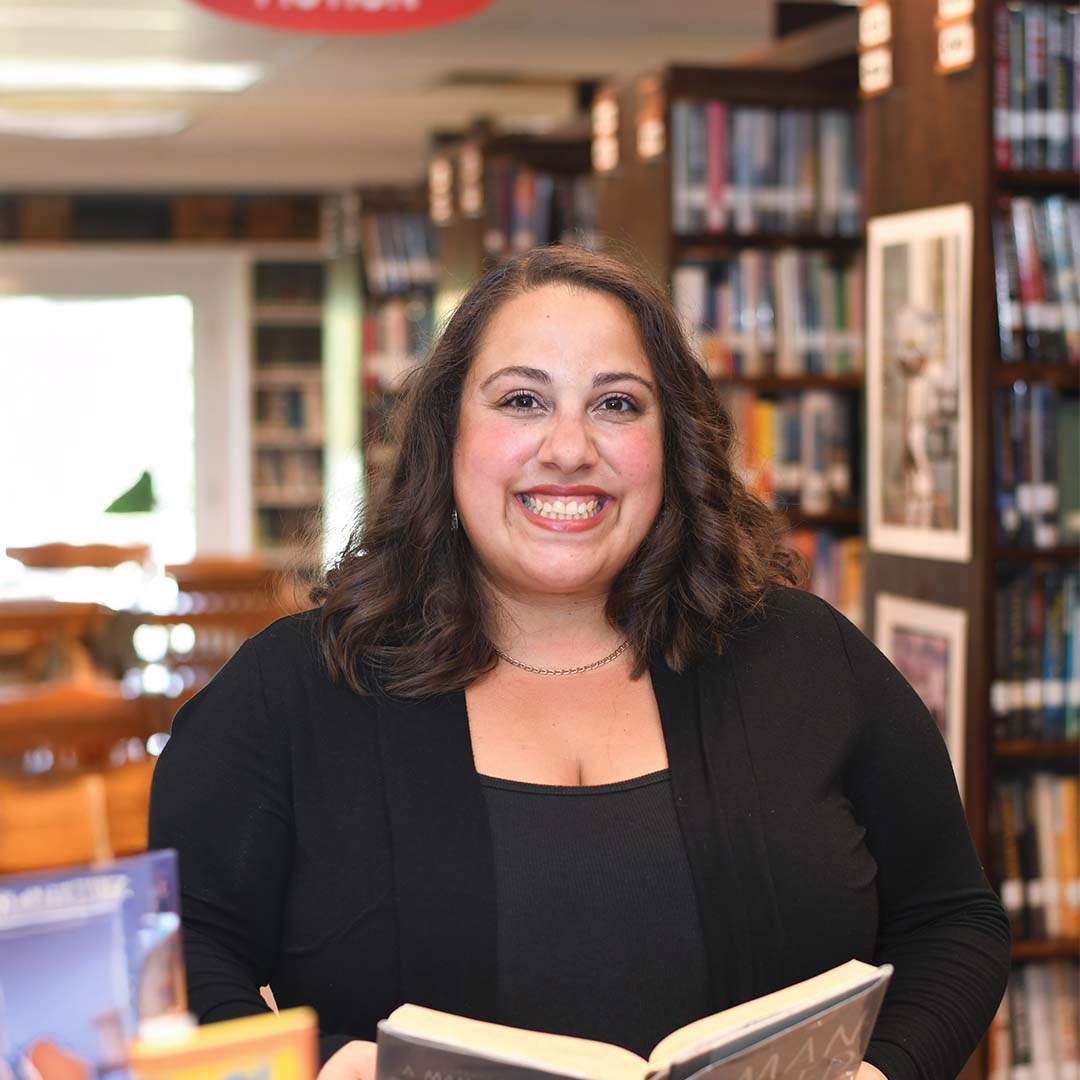
For Katryna Cera-Proulx, a teenage volunteer position became a calling.
When Katryna Cera-Proulx was 15, her parents decided to divorce. Looking for a healthy distraction versus a path to partying, she volunteered at the Corbit-Calloway Memorial Library in Odessa, located near her Middletown home. “I never left,” she says.
In 2010, she joined the staff and gradually took on responsibilities in circulation, children’s programming, and other roles. In 2021, she was named director. Regardless of the job title, her library work combines two things she values: helping people and creating connections.
The Path to Delaware
Cera-Proulx was born in Montreal to a French-Canadian mother and Colombian father. He had immigrated to the United States as a teenager in 1979 and later moved to Canada for a job. There were more moves to follow. The family lived in Miami and North Carolina before he accepted a position with the DuPont Co., and they relocated to Delaware. She was 9.
Being raised by immigrant parents gave Cera-Proulx a different perspective from many other classmates, one for which she is thankful, she says. Although French was her first language, she attended a Spanish-language school in North Carolina. After arriving in Delaware, she entered an English-only classroom. Because she initially fell behind in her studies, her teachers encouraged the family to speak English at home. Even now, she says, her sentence structure may reflect the interplay of English and Spanish. Her grandmother, who does not speak English, now lives with her, so Cera-Proulx speaks Spanish every day.
Because she is trilingual, she considered a career in international business after graduating from Middletown High School. At Delaware Technical Community College, she explored early childhood education and nursing. Meanwhile, Karen Quinn, then the library’s director, repeatedly told Cera-Proulx she would make a good librarian. As the young adult gained experience with programming, inventory, and other operations, the idea took hold.
“Oh my gosh, I could be a librarian,” she says. Her career path became clear.
The Right Approach
Cera-Proulx needed a bachelor’s degree before pursuing the master’s degree required for professional librarianship. Wilmington University’s flexible course options made the school the ideal choice. She majored in General Studies, worked at the library, and helped her father raise her sister, who is 10 years younger. (Her mother had returned to Canada.) A traditional daytime schedule would have been difficult to manage.
The Ada Leigh Soles Memorial Professional Librarian and Archivist Scholarship helped pay for her undergraduate education. The state program supports eligible Delaware library and archive employees pursuing a bachelor’s, master’s, or doctoral degree related to the profession.
Cera-Proulx earned a master’s degree in Library and Information Science from the University of South Florida. Before the pandemic, she completed one semester toward earning a doctorate in Education in Organizational Leadership, Learning, and Innovation at WilmU. She hopes to return to her studies, since directing a library requires expertise in administration, fundraising, delegation, and management as well as librarianship, she says.
One college course that influenced her leadership wasn’t an obvious one. In a yoga class, which explored the philosophy behind the practice, the instructor discussed priorities. She used the example of choosing to play ping-pong with her son instead of immediately washing the dishes. The dishes could wait. Cera-Proulx applied the lesson to library service. “This patron is here. I’m going to talk to this patron, see how this patron is doing, see if they need anything. I’ll finish this administrative work later, because it’ll be there,” she says.
Quinn taught Cera-Proulx that serving the public doesn’t always mean locating a book or answering a research question. A visitor may need a cool place to sit on a hot day. Someone grieving a parent may need a listener. The idea of service reflects a role that public libraries have played for generations.
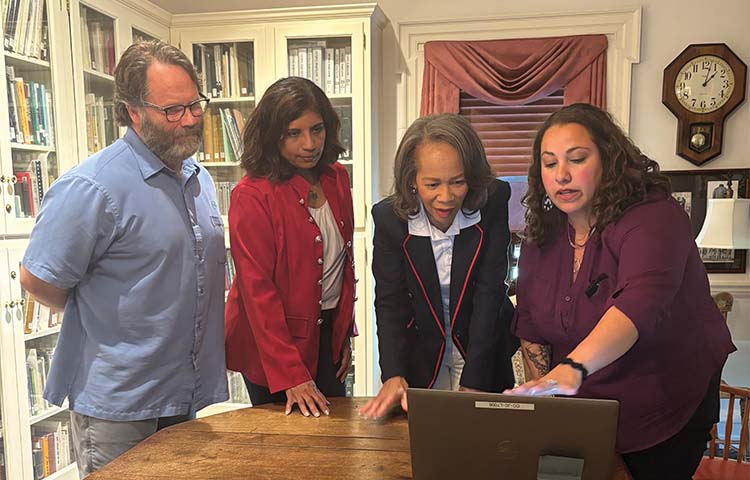
Katryna Cera-Proulx, along with board members Scott Davis and Sital Soni, shows Sen. Lisa Blunt Rochester plans for the new library.
The Past and the Future
Unlike private subscription libraries, the free public libraries that emerged in the 19th century did not require visitors to pay dues or make a purchase. By the late 19th and early 20th centuries, many had added children’s rooms, lectures, and community activities.
Founded through a bequest from Dr. James Corbit, the Corbit-Calloway Memorial Library opened in 1848 as Delaware’s first free public library open to all, including women and children. The current building was built in 1968 and expanded in 1986. Today, the 6,100-square-foot library houses nearly 55,000 items and receives more than 35,000 visits annually.
Along with books, today’s libraries also offer internet access and classes. For instance, Corbit-Calloway offers or has hosted story times, STEM activities, pottery, yoga, book clubs and community events. Staff members also connect patrons with legal, social-service, and other outside resources.
Cera-Proulx draws on her personal experiences when working with patrons, especially those who speak English as a second language. Her immigrant background and experience adapting to new schools and languages help her understand what it feels like to be an outsider, she says. Patrons from diverse backgrounds have told the staff that they feel welcome at the library. Cera-Proulx considers that one of the library’s most meaningful accomplishments.
But keeping pace with area growth has been a challenge.
A $10 million campaign seeks to fund a renovation and expansion, including study rooms, flexible meeting areas, upgraded infrastructure, a technology center, and dedicated spaces for children, teens, and adults.
The enhancements would keep the library relevant to future generations. Quinn, who now works in Children’s Services at the library, sees grandparents return with grandchildren after bringing their own children to her story times years ago. Cera-Proulx wants to experience that same cycle. She loves when parents send her photographs of children continuing a STEM project at home. One mother sent an image of her triplets standing beside the sunflowers they had planted during a library activity.
As the Middletown, Odessa and Townsend area — dubbed MOT — expands, Cera-Proulx is determined to keep the welcoming atmosphere that her predecessors fostered. She has no desire to move on from the Corbit-Calloway. Instead, she wants to guide the expansion, welcome new residents, and continue watching new generations discover the library.
“I have found my place,” she says.
—Pam George

Want to read more in-depth stories? Explore our latest magazine articles.
For Katryna Cera-Proulx, a teenage volunteer position became a calling.
When Katryna Cera-Proulx was 15, her parents decided to divorce. Looking for a healthy distraction versus a path to partying, she volunteered at the Corbit-Calloway Memorial Library in Odessa, located near her Middletown home. “I never left,” she says.
In 2010, she joined the staff and gradually took on responsibilities in circulation, children’s programming, and other roles. In 2021, she was named director. Regardless of the job title, her library work combines two things she values: helping people and creating connections.
The Path to Delaware
Cera-Proulx was born in Montreal to a French-Canadian mother and Colombian father. He had immigrated to the United States as a teenager in 1979 and later moved to Canada for a job. There were more moves to follow. The family lived in Miami and North Carolina before he accepted a position with the DuPont Co., and they relocated to Delaware. She was 9.
Being raised by immigrant parents gave Cera-Proulx a different perspective from many other classmates, one for which she is thankful, she says. Although French was her first language, she attended a Spanish-language school in North Carolina. After arriving in Delaware, she entered an English-only classroom. Because she initially fell behind in her studies, her teachers encouraged the family to speak English at home. Even now, she says, her sentence structure may reflect the interplay of English and Spanish. Her grandmother, who does not speak English, now lives with her, so Cera-Proulx speaks Spanish every day.
Because she is trilingual, she considered a career in international business after graduating from Middletown High School. At Delaware Technical Community College, she explored early childhood education and nursing. Meanwhile, Karen Quinn, then the library’s director, repeatedly told Cera-Proulx she would make a good librarian. As the young adult gained experience with programming, inventory, and other operations, the idea took hold.
“Oh my gosh, I could be a librarian,” she says. Her career path became clear.
The Right Approach
Cera-Proulx needed a bachelor’s degree before pursuing the master’s degree required for professional librarianship. Wilmington University’s flexible course options made the school the ideal choice. She majored in General Studies, worked at the library, and helped her father raise her sister, who is 10 years younger. (Her mother had returned to Canada.) A traditional daytime schedule would have been difficult to manage.
The Ada Leigh Soles Memorial Professional Librarian and Archivist Scholarship helped pay for her undergraduate education. The state program supports eligible Delaware library and archive employees pursuing a bachelor’s, master’s, or doctoral degree related to the profession.
Cera-Proulx earned a master’s degree in Library and Information Science from the University of South Florida. Before the pandemic, she completed one semester toward earning a doctorate in Education in Organizational Leadership, Learning, and Innovation at WilmU. She hopes to return to her studies, since directing a library requires expertise in administration, fundraising, delegation, and management as well as librarianship, she says.
One college course that influenced her leadership wasn’t an obvious one. In a yoga class, which explored the philosophy behind the practice, the instructor discussed priorities. She used the example of choosing to play ping-pong with her son instead of immediately washing the dishes. The dishes could wait. Cera-Proulx applied the lesson to library service. “This patron is here. I’m going to talk to this patron, see how this patron is doing, see if they need anything. I’ll finish this administrative work later, because it’ll be there,” she says.
Quinn taught Cera-Proulx that serving the public doesn’t always mean locating a book or answering a research question. A visitor may need a cool place to sit on a hot day. Someone grieving a parent may need a listener. The idea of service reflects a role that public libraries have played for generations.
Katryna Cera-Proulx, along with board members Scott Davis and Sital Soni, shows Sen. Lisa Blunt Rochester plans for the new library.
The Past and the Future
Unlike private subscription libraries, the free public libraries that emerged in the 19th century did not require visitors to pay dues or make a purchase. By the late 19th and early 20th centuries, many had added children’s rooms, lectures, and community activities.
Founded through a bequest from Dr. James Corbit, the Corbit-Calloway Memorial Library opened in 1848 as Delaware’s first free public library open to all, including women and children. The current building was built in 1968 and expanded in 1986. Today, the 6,100-square-foot library houses nearly 55,000 items and receives more than 35,000 visits annually.
Along with books, today’s libraries also offer internet access and classes. For instance, Corbit-Calloway offers or has hosted story times, STEM activities, pottery, yoga, book clubs and community events. Staff members also connect patrons with legal, social-service, and other outside resources.
Cera-Proulx draws on her personal experiences when working with patrons, especially those who speak English as a second language. Her immigrant background and experience adapting to new schools and languages help her understand what it feels like to be an outsider, she says. Patrons from diverse backgrounds have told the staff that they feel welcome at the library. Cera-Proulx considers that one of the library’s most meaningful accomplishments.
But keeping pace with area growth has been a challenge.
A $10 million campaign seeks to fund a renovation and expansion, including study rooms, flexible meeting areas, upgraded infrastructure, a technology center, and dedicated spaces for children, teens, and adults.
The enhancements would keep the library relevant to future generations. Quinn, who now works in Children’s Services at the library, sees grandparents return with grandchildren after bringing their own children to her story times years ago. Cera-Proulx wants to experience that same cycle. She loves when parents send her photographs of children continuing a STEM project at home. One mother sent an image of her triplets standing beside the sunflowers they had planted during a library activity.
As the Middletown, Odessa and Townsend area — dubbed MOT — expands, Cera-Proulx is determined to keep the welcoming atmosphere that her predecessors fostered. She has no desire to move on from the Corbit-Calloway. Instead, she wants to guide the expansion, welcome new residents, and continue watching new generations discover the library.
“I have found my place,” she says.
—Pam George
Want to read more in-depth stories? Explore our latest magazine articles.