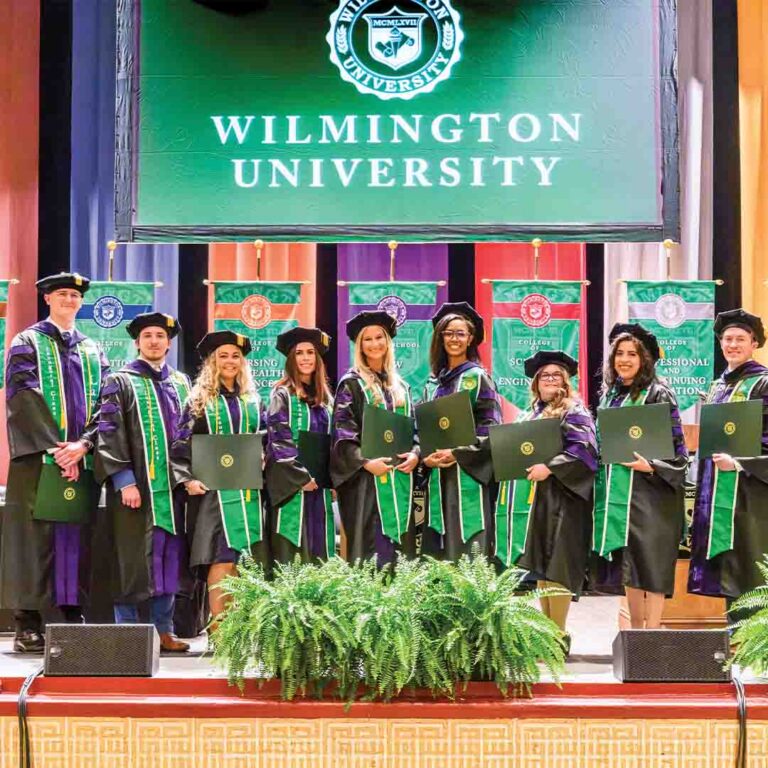

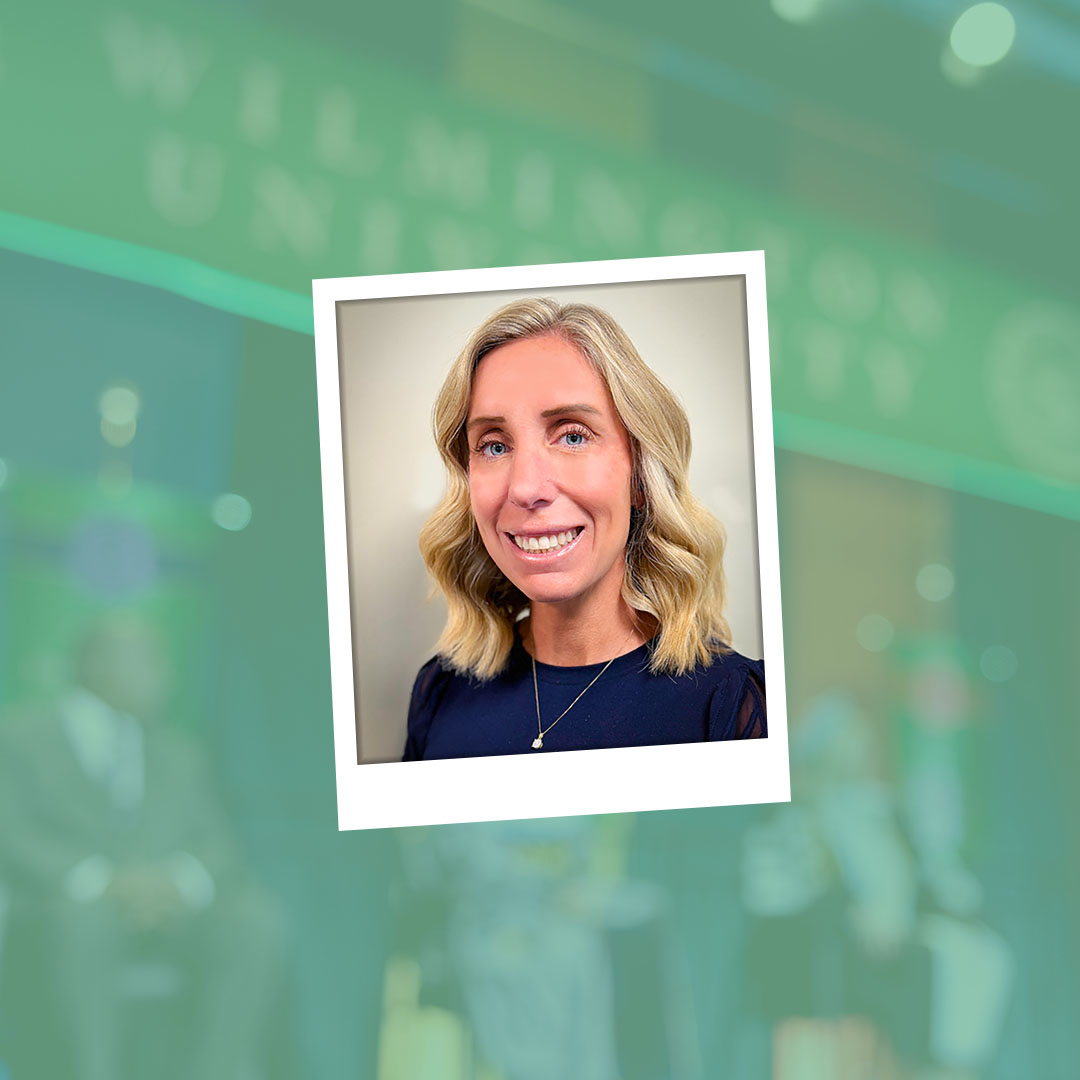
Dr. Meghan Catts was a 2026 commencement speaker representing the University’s College of Education and Liberal Arts.
With 18 years of experience across elementary and middle school education, she has served as a classroom teacher, gifted education teacher, and school administrator. Dr. Catts has recently started a new role as assistant principal for Cape Henlopen High School. She is deeply committed to advancing equity and expanding access to rigorous learning opportunities for all students.
Q: Can you tell us about your WilmU journey and what prompted you to choose the Ed.D. in Educational Leadership program?
I had always dreamed of earning my doctorate; however, I began this journey much sooner than expected. I had just achieved National Board Certified Teacher status as an Exceptional Needs Specialist and had earned a certificate from the University of Delaware. I was going to wait to start my doctorate, but there was a large cohort made up of Cape Henlopen School District educators starting that I wanted to join. I was lucky enough to be accepted to WilmU with seven other Cape staff members!
Q: Was there a specific moment when you knew that WilmU was the right fit for you?
The professors and cohort model are the best components of WilmU’s doctoral program. All the professors understand that we are working educators that have professions and families to balance.
Q: Looking back, which course, project, or assignment had the most significant impact on you and why?
As a new school leader, I found the Managing Finance course to be the most interesting. Previously, as a classroom teacher, I did not deal in any aspects of school finance or budgeting. This course helped me to learn the larger picture of the financial side of education. We took time to analyze state and district budgets and various funding sources. This helped me to be a stronger leader and build my capacity to have budgeting conversations with my staff.
Q: What skills or perspectives have you gained along the way that you didn’t anticipate?
Throughout the program, I learned to use improvement science to move beyond simply “admiring problems.” I developed the research skills to understand the root causes of educational challenges, explore evidence-based solutions, and apply what I learned to improve outcomes for students and schools. That ability to turn research into meaningful action has been invaluable.
Q: If you could sum up your WilmU experience in one sentence, what would it be?
My WilmU doctoral experience challenged my critical thinking, expanded my educational knowledge base, and helped me to apply improvement science and research-based practices to improve students’ educational outcomes.
“My WilmU doctoral experience challenged my critical thinking, expanded my educational knowledge base, and helped me to apply improvement science and research-based practices to improve students’ educational outcomes.”
— Dr. Meghan Catts
Q. Now that you’ve completed your degree, what’s next for you?
I will continue my career in school administration. I am moving into administration at the high school level, so I will continue expanding my knowledge. I hope to ultimately apply for a job as head principal within my district.
Q: How do you hope to make an impact in your field or community?
I want to continue to work with improving educational equity for all students in whatever capacity my future jobs hold. I have moved from elementary to middle and now on to high school, and equity in educational programming for all students is important at every level! All students should be provided with high-quality learning experiences that make them enjoy and appreciate school as much as I do.
Q: Can you share any words of wisdom, advice, or encouragement for people who are thinking about taking their education further?
Make sure to carve out time for this process! I used to complain to my family about how much work I had in addition to teaching full time. My husband always reminded me, “They don’t give doctorates to just anyone!” Earning a doctoral or any post-secondary degree requires a substantial amount of time and effort. Make space in your life for this process so it can be worthwhile and actually help to improve your craft of education.
Q: Lastly, is there anyone you would like to acknowledge for playing a key role in supporting your journey?
Too many to mention! I am beyond thankful for my advisor, Dr. Katie Harrison, for helping to move along my dissertation in practice and for providing boundless support! I am also very grateful to Dr. Susan Bunting and Dr. Nancy Carnevale for their constant support and belief in me throughout this process; they saw something greater in me and helped me to realize it in myself!
Wilmington University’s Ed.D. in Educational Leadership program facilitates the professional development of teachers, specialists, administrators, and other educational leaders committed to the concept that those responsible for the nation’s educational agenda must be courageous and innovative problem-solvers.
Dr. Meghan Catts was a 2026 commencement speaker representing the University’s College of Education and Liberal Arts.
With 18 years of experience across elementary and middle school education, she has served as a classroom teacher, gifted education teacher, and school administrator. Dr. Catts has recently started a new role as assistant principal for Cape Henlopen High School. She is deeply committed to advancing equity and expanding access to rigorous learning opportunities for all students.
Q: Can you tell us about your WilmU journey and what prompted you to choose the Ed.D. in Educational Leadership program?
I had always dreamed of earning my doctorate; however, I began this journey much sooner than expected. I had just achieved National Board Certified Teacher status as an Exceptional Needs Specialist and had earned a certificate from the University of Delaware. I was going to wait to start my doctorate, but there was a large cohort made up of Cape Henlopen School District educators starting that I wanted to join. I was lucky enough to be accepted to WilmU with seven other Cape staff members!
Q: Was there a specific moment when you knew that WilmU was the right fit for you?
The professors and cohort model are the best components of WilmU’s doctoral program. All the professors understand that we are working educators that have professions and families to balance.
Q: Looking back, which course, project, or assignment had the most significant impact on you and why?
As a new school leader, I found the Managing Finance course to be the most interesting. Previously, as a classroom teacher, I did not deal in any aspects of school finance or budgeting. This course helped me to learn the larger picture of the financial side of education. We took time to analyze state and district budgets and various funding sources. This helped me to be a stronger leader and build my capacity to have budgeting conversations with my staff.
Q: What skills or perspectives have you gained along the way that you didn’t anticipate?
Throughout the program, I learned to use improvement science to move beyond simply “admiring problems.” I developed the research skills to understand the root causes of educational challenges, explore evidence-based solutions, and apply what I learned to improve outcomes for students and schools. That ability to turn research into meaningful action has been invaluable.
Q: If you could sum up your WilmU experience in one sentence, what would it be?
My WilmU doctoral experience challenged my critical thinking, expanded my educational knowledge base, and helped me to apply improvement science and research-based practices to improve students’ educational outcomes.
“My WilmU doctoral experience challenged my critical thinking, expanded my educational knowledge base, and helped me to apply improvement science and research-based practices to improve students’ educational outcomes.”
— Dr. Meghan Catts
Q. Now that you’ve completed your degree, what’s next for you?
I will continue my career in school administration. I am moving into administration at the high school level, so I will continue expanding my knowledge. I hope to ultimately apply for a job as head principal within my district.
Q: How do you hope to make an impact in your field or community?
I want to continue to work with improving educational equity for all students in whatever capacity my future jobs hold. I have moved from elementary to middle and now on to high school, and equity in educational programming for all students is important at every level! All students should be provided with high-quality learning experiences that make them enjoy and appreciate school as much as I do.
Q: Can you share any words of wisdom, advice, or encouragement for people who are thinking about taking their education further?
Make sure to carve out time for this process! I used to complain to my family about how much work I had in addition to teaching full time. My husband always reminded me, “They don’t give doctorates to just anyone!” Earning a doctoral or any post-secondary degree requires a substantial amount of time and effort. Make space in your life for this process so it can be worthwhile and actually help to improve your craft of education.
Q: Lastly, is there anyone you would like to acknowledge for playing a key role in supporting your journey?
Too many to mention! I am beyond thankful for my advisor, Dr. Katie Harrison, for helping to move along my dissertation in practice and for providing boundless support! I am also very grateful to Dr. Susan Bunting and Dr. Nancy Carnevale for their constant support and belief in me throughout this process; they saw something greater in me and helped me to realize it in myself!
Wilmington University’s Ed.D. in Educational Leadership program facilitates the professional development of teachers, specialists, administrators, and other educational leaders committed to the concept that those responsible for the nation’s educational agenda must be courageous and innovative problem-solvers.