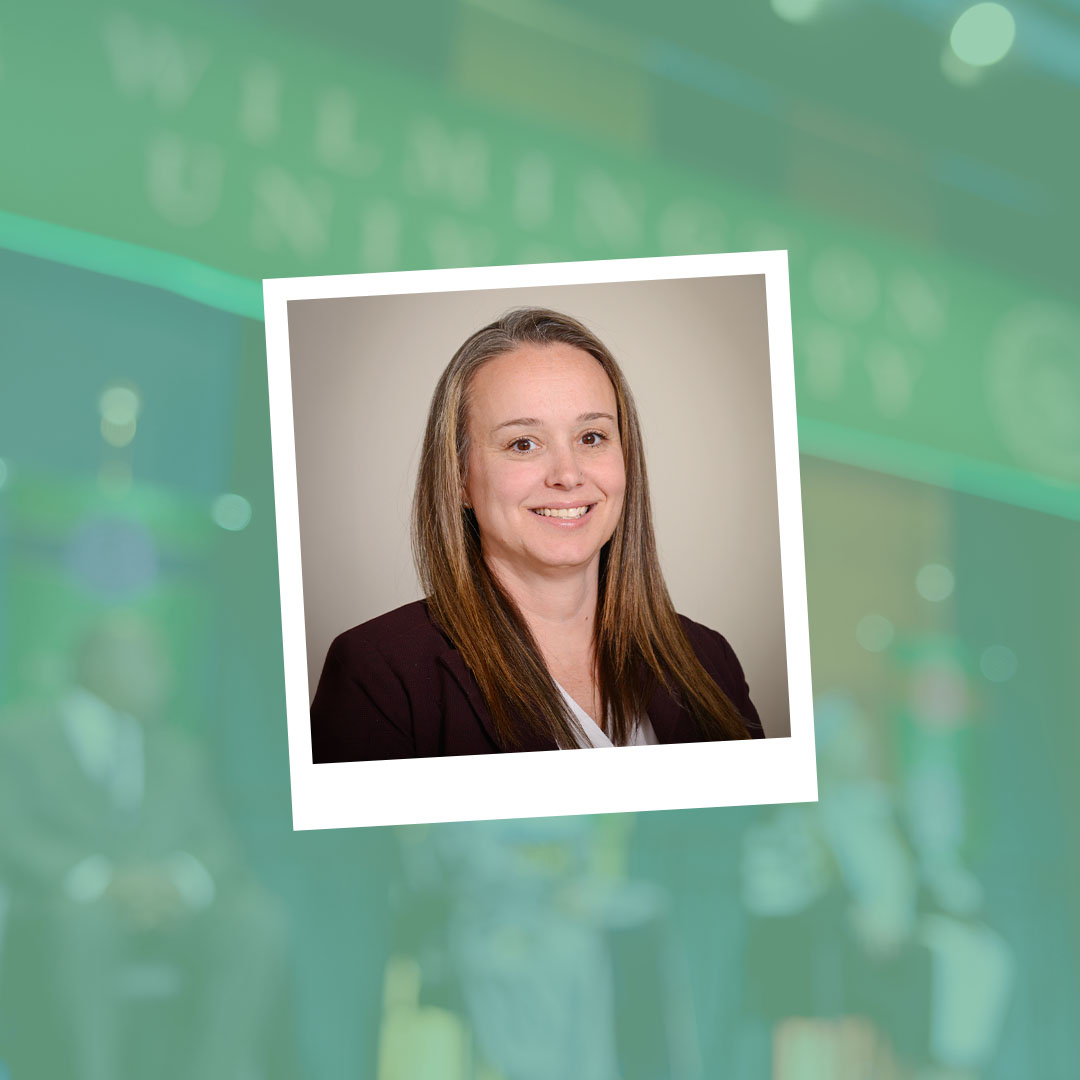
Dr. Kasey Mears was a 2026 commencement speaker representing the WilmU College of Social and Behavioral Sciences.
An Army veteran who has studied veteran well-being for two decades, she has built a professional and academic career focused on psychology, human services, prevention science, and healthcare leadership. Dr. Mears serves as director of clinical engineering for Trinity Health, where she provides leadership for the maintenance, safety, and performance of essential medical equipment across hospitals in the Mid-Atlantic region.
Q: Can you tell us about your WilmU journey and what prompted you to choose the Doctor of Prevention Science Program?
My journey with Wilmington University began when I transferred from another local college’s Master of Social Work (MSW) program. Around 2014, I transitioned into the M.S. in Human Services program at WilmU. That move was very intentional for me. I was looking for a university that offered flexibility, academic rigor, and programs that aligned more closely with my long-term professional goals.
From the moment I joined the WilmU community, I felt supported by faculty and programs that valued real-world impact and student growth. After I completed my master’s program, I spent a significant amount of time researching doctoral pathways that would allow me to further my education while staying true to my passion for prevention, health equity, and service. I was particularly focused on identifying a program that would equip me with the skills and perspective needed to better support veteran populations.
The Doctor of Prevention Science program stood out as the right fit because of its emphasis on upstream prevention, evidence‑based practice, and systems‑level thinking. Choosing this program felt like a natural next step in my WilmU journey, one that allows me to build on my academic foundation while advancing my mission to make a meaningful difference in the lives of veterans and their communities.
Q: Was there a specific moment when you knew that WilmU was the right fit for you?
Yes, there was a very clear moment when I knew Wilmington University was the right fit for me. When I was well into the coursework for the MSW program at the other college, I came to the realization that the required work‑study component simply wasn’t compatible with my reality of working full time while also being a full‑time student. I knew that if I wanted to be successful academically without sacrificing my professional responsibilities, I needed a university that truly understood and supported adult learners.
As I explored WilmU, it became evident that flexibility was built into the structure of the programs, not treated as an exception. The scheduling options, online and hybrid formats, and overall understanding of working professionals made me feel seen and supported. The realization that WilmU valued academic quality and recognized the complex responsibilities its students juggle was the moment I knew this was the right place for me.
Q: Looking back, which course, project, or assignment had the most significant impact on you and why?
Looking back, the assignments that had the most significant impact on me were those that focused on research and data. While I genuinely enjoyed most of the coursework, the qualitative, quantitative, and mixed methods research courses stood out the most. Those projects helped me develop a deeper appreciation for how critical data is — not just collecting it, but truly understanding, evaluating, and applying it to inform decision making. Through those assignments, I gained a stronger grasp of how evidence drives effective prevention and intervention strategies.
Learning to analyze data from multiple perspectives and translate findings into meaningful conclusions reinforced the importance of using research to guide practice and policy. That foundation has stayed with me and continues to influence how I approach problems, evaluate outcomes, and think critically about work aimed at improving community and population health, especially for the veteran populations I am passionate about serving.
Q: What skills or perspectives have you gained along the way that you didn’t anticipate?
One of the most meaningful perspectives I gained, and something I didn’t fully anticipate, was a deeper understanding of how much words truly matter. Throughout the program, I became more aware that not only what you say, but also how you say it, the order you say it in, and the way information is presented can completely change meaning and impact. This became especially clear through research, writing, and data interpretation.
I learned how important it is to be precise, whether you’re stating conclusions, framing a problem, or asking a research question. Saying exactly what you mean, or clearly defining what you’re seeking to answer, can shape outcomes, influence understanding, and guide decision making. That awareness has stayed with me and has strengthened both my academic work and my professional communication.
Q: If you could sum up your WilmU experience in one sentence, what would it be?
My WilmU experience has been a transformative journey that strengthened my skills, sharpened my purpose, and prepared me to make a meaningful impact in prevention science and service to others.
“From the moment I joined the WilmU community, I felt supported by faculty and programs that valued real-world impact and student growth.”
— Dr. Kasey Mears
Q: Now that you’ve completed your degree, what’s next for you?
After completing my degree, I’ve expanded my role with Trinity Health and am actively seeking opportunities to build on my research interests, particularly around veterans’ health and prevention. My goal is to contribute evidence‑basedwork that meaningfully improves outcomes and quality of life for veterans.
Q: How do you hope to make an impact in your field or community?
I aim to make a difference by contributing research that leads to thoughtful, data‑driven improvements in how veterans are supported. Whether through program evaluation, prevention strategies, or policy‑informed initiatives, my focus is always on creating measurable improvements in veterans’ lives.
Q: Can you share any words of wisdom, advice, or encouragement for people who are thinking about taking their education further?
One of the most important lessons I’ve learned is the power of showing up and continuing to show up, even when it feels difficult or inconvenient. Consistency matters, and progress often comes from simply staying committed and present, one step at a time.
Q: Lastly, is there anyone you would like to acknowledge for playing a key role in supporting your journey?
There are several people I would like to acknowledge for playing a key role in supporting my journey. First, I am deeply grateful to Dr. Edward Guthrie (retired) and Dr. Shawn Stevens for their guidance and mentorship throughout the program. I would also like to thank Dr. Jose Reyes Ramirez for consistently challenging me to think differently and expand my perspective. Dr. Kelly Cheeseman and Dr. Jim Warwick deserve recognition for their patience and steady support, and Dr. Marissa DiSanto for her thoughtful feedback and final edits that helped bring everything together.
I also want to extend my heartfelt thanks to my husband and my children for their unwavering support, patience, and understanding over the past three years. They tolerated long nights, busy schedules, and the many challenges that came with this journey, and I truly could not have done this without them. Lastly, I want to acknowledge the members of Cohort 11, who have become not only colleagues but also some of the finest doctors and friends that I have the privilege to know. Their encouragement and shared commitment made this experience both meaningful and unforgettable.
Address the challenges facing families, communities, and individuals in WilmU’s Doctor of Prevention Science program.
Dr. Kasey Mears was a 2026 commencement speaker representing the WilmU College of Social and Behavioral Sciences.
An Army veteran who has studied veteran well-being for two decades, she has built a professional and academic career focused on psychology, human services, prevention science, and healthcare leadership. Dr. Mears serves as director of clinical engineering for Trinity Health, where she provides leadership for the maintenance, safety, and performance of essential medical equipment across hospitals in the Mid-Atlantic region.
Q: Can you tell us about your WilmU journey and what prompted you to choose the Doctor of Prevention Science Program?
My journey with Wilmington University began when I transferred from another local college’s Master of Social Work (MSW) program. Around 2014, I transitioned into the M.S. in Human Services program at WilmU. That move was very intentional for me. I was looking for a university that offered flexibility, academic rigor, and programs that aligned more closely with my long-term professional goals.
From the moment I joined the WilmU community, I felt supported by faculty and programs that valued real-world impact and student growth. After I completed my master’s program, I spent a significant amount of time researching doctoral pathways that would allow me to further my education while staying true to my passion for prevention, health equity, and service. I was particularly focused on identifying a program that would equip me with the skills and perspective needed to better support veteran populations.
The Doctor of Prevention Science program stood out as the right fit because of its emphasis on upstream prevention, evidence‑based practice, and systems‑level thinking. Choosing this program felt like a natural next step in my WilmU journey, one that allows me to build on my academic foundation while advancing my mission to make a meaningful difference in the lives of veterans and their communities.
Q: Was there a specific moment when you knew that WilmU was the right fit for you?
Yes, there was a very clear moment when I knew Wilmington University was the right fit for me. When I was well into the coursework for the MSW program at the other college, I came to the realization that the required work‑study component simply wasn’t compatible with my reality of working full time while also being a full‑time student. I knew that if I wanted to be successful academically without sacrificing my professional responsibilities, I needed a university that truly understood and supported adult learners.
As I explored WilmU, it became evident that flexibility was built into the structure of the programs, not treated as an exception. The scheduling options, online and hybrid formats, and overall understanding of working professionals made me feel seen and supported. The realization that WilmU valued academic quality and recognized the complex responsibilities its students juggle was the moment I knew this was the right place for me.
Q: Looking back, which course, project, or assignment had the most significant impact on you and why?
Looking back, the assignments that had the most significant impact on me were those that focused on research and data. While I genuinely enjoyed most of the coursework, the qualitative, quantitative, and mixed methods research courses stood out the most. Those projects helped me develop a deeper appreciation for how critical data is — not just collecting it, but truly understanding, evaluating, and applying it to inform decision making. Through those assignments, I gained a stronger grasp of how evidence drives effective prevention and intervention strategies.
Learning to analyze data from multiple perspectives and translate findings into meaningful conclusions reinforced the importance of using research to guide practice and policy. That foundation has stayed with me and continues to influence how I approach problems, evaluate outcomes, and think critically about work aimed at improving community and population health, especially for the veteran populations I am passionate about serving.
Q: What skills or perspectives have you gained along the way that you didn’t anticipate?
One of the most meaningful perspectives I gained, and something I didn’t fully anticipate, was a deeper understanding of how much words truly matter. Throughout the program, I became more aware that not only what you say, but also how you say it, the order you say it in, and the way information is presented can completely change meaning and impact. This became especially clear through research, writing, and data interpretation.
I learned how important it is to be precise, whether you’re stating conclusions, framing a problem, or asking a research question. Saying exactly what you mean, or clearly defining what you’re seeking to answer, can shape outcomes, influence understanding, and guide decision making. That awareness has stayed with me and has strengthened both my academic work and my professional communication.
Q: If you could sum up your WilmU experience in one sentence, what would it be?
My WilmU experience has been a transformative journey that strengthened my skills, sharpened my purpose, and prepared me to make a meaningful impact in prevention science and service to others.
“From the moment I joined the WilmU community, I felt supported by faculty and programs that valued real-world impact and student growth.”
— Dr. Kasey Mears
Q: Now that you’ve completed your degree, what’s next for you?
After completing my degree, I’ve expanded my role with Trinity Health and am actively seeking opportunities to build on my research interests, particularly around veterans’ health and prevention. My goal is to contribute evidence‑basedwork that meaningfully improves outcomes and quality of life for veterans.
Q: How do you hope to make an impact in your field or community?
I aim to make a difference by contributing research that leads to thoughtful, data‑driven improvements in how veterans are supported. Whether through program evaluation, prevention strategies, or policy‑informed initiatives, my focus is always on creating measurable improvements in veterans’ lives.
Q: Can you share any words of wisdom, advice, or encouragement for people who are thinking about taking their education further?
One of the most important lessons I’ve learned is the power of showing up and continuing to show up, even when it feels difficult or inconvenient. Consistency matters, and progress often comes from simply staying committed and present, one step at a time.
Q: Lastly, is there anyone you would like to acknowledge for playing a key role in supporting your journey?
There are several people I would like to acknowledge for playing a key role in supporting my journey. First, I am deeply grateful to Dr. Edward Guthrie (retired) and Dr. Shawn Stevens for their guidance and mentorship throughout the program. I would also like to thank Dr. Jose Reyes Ramirez for consistently challenging me to think differently and expand my perspective. Dr. Kelly Cheeseman and Dr. Jim Warwick deserve recognition for their patience and steady support, and Dr. Marissa DiSanto for her thoughtful feedback and final edits that helped bring everything together.
I also want to extend my heartfelt thanks to my husband and my children for their unwavering support, patience, and understanding over the past three years. They tolerated long nights, busy schedules, and the many challenges that came with this journey, and I truly could not have done this without them. Lastly, I want to acknowledge the members of Cohort 11, who have become not only colleagues but also some of the finest doctors and friends that I have the privilege to know. Their encouragement and shared commitment made this experience both meaningful and unforgettable.
Address the challenges facing families, communities, and individuals in WilmU’s Doctor of Prevention Science program.