WilmU One-on-One: Meet Andy Sinclair, Faculty Member and 2026 VISTA NextGen Superstar

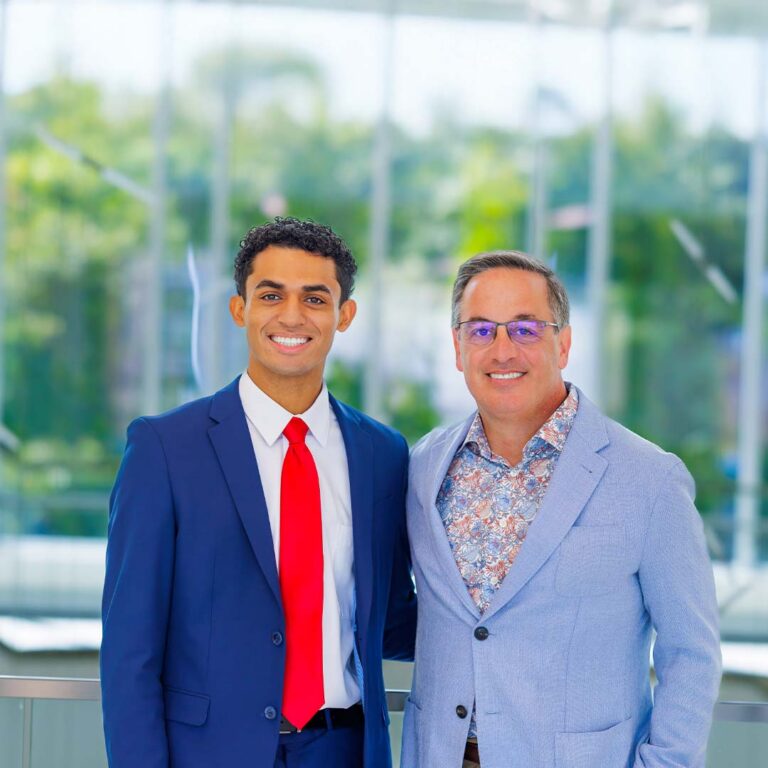
On April 30, Andy Sinclair, Wilmington University alumnus, assistant professor, and chair of Business Analytics and Applied Technology programs, was recognized as a 2026 VISTA NextGen Superstar at a reception held on the Penn State Great Valley campus in Malvern, PA.
Hosted annually by VISTA TODAY, the event honors 40 standout Chester County professionals who have made significant contributions in their respective fields and their communities prior to reaching the age of 40. In addition to his work at Wilmington University, Andy is currently a Ph.D. candidate at Florida Atlantic University, pursuing a doctorate in Computer Science with a focus on Data Science, where his research centers on applied machine learning and solving industry problems. Andy has been selected as a Fulbright Specialist and a Case Research Foundation Paul R. Lawrence Fellow.
Q. Congratulations, Andy! VISTA’s NextGen Superstars are recognized for leading, innovating, and driving positive change. Can you tell us how you define effective leadership?
To me, effective leadership starts with clarity. You first need to understand the goal, the mission, and what success truly looks like. Once that is clear, leadership brings together the right people, recognizes their strengths, and puts them in positions where they can thrive and contribute in meaningful ways.
Great leaders do not try to do everything themselves. Instead, they build strong teams, empower others, and create an environment where people feel trusted, supported, and challenged to grow. Every person brings a different set of experiences, skills, and perspectives, and strong leadership is about recognizing that value and helping individuals reach their full potential while working toward a shared objective.
Q. You’ve worked in both industry and higher education. Can you share how your journey led you to Wilmington University?
My journey to Wilmington University really reflects the path I have taken professionally and academically. I first came to WilmU as a transfer student from Delaware Technical Community College while working full time. At that point in my life, I was already involved in a small business environment and was seeing firsthand how quickly organizations can grow when the right systems, people, and processes are in place.
As my career developed, I decided to continue my education by pursuing a graduate degree in Business Intelligence and Analytics at Saint Joseph’s University in Philadelphia. That experience helped me build a much stronger foundation in databases, coding, analytics, and process improvement. It also gave me a new perspective on how data and technology can solve real businessproblems.
Over time, I realized I wanted to bring those experiences into the classroom. I saw an opportunity to contribute as an adjunct in Wilmington University’s Business Analytics program, and I quickly found that I loved helping students connect what they were learning to real-world applications. After a few years, the Assistant Chair opportunity became available, and I jumped at the chance to serve in a larger leadership role. That path eventually led me to where I am today, now leading the Business Analytics and Applied Technology programs.
Q. How have your experiences in industry shaped your teaching philosophy and approach in the classroom?
My experiences in industry have shaped my teaching philosophy in a very direct way because my own educational path was not traditional. I understand what it feels like to balance work, school, growth, and uncertainty, and that perspective stays with me every time I walk into a classroom.
I often think of the Benjamin Franklin quote: “Tell me and I forget. Teach me and I remember. Involve me and I learn.” That idea has stayed central to how I approach teaching. The educators who made the biggest impact on me were the ones who involved students in the process, made learning practical, and adapted to the needs of the individual rather than assuming every student learns the same way.
After high school, I enrolled in a state university but quickly realized I wanted to gain more life and career experience before fully finishing that chapter. Over the next decade, I built my career, reached a point where I wanted more, and recognized that education would help me grow further. I returned to complete my undergraduate studies in person while working and later pursued graduate studies online. Because of that journey, I understand that students come to the classroom with very different life experiences, responsibilities, and goals.
That is why I try to make learning relevant, practical, and adaptable. I want students to see how the material connects to real decisions, real businesses, and real opportunities. I also want them to feel seen and supported. My goal is to not just teach content, but to create an environment where students can grow confidently, develop practical skills, and believe in what is possible for themselves.
— Andy Sinclair
What matters most is staying committed to your goal, even if progress happens one step at a time.
Q. What excites you most about the fields of business analytics and applied technology right now?
What excites me most is how fast these fields continue to evolve and how relevant they have become to nearly every industry. Business analytics is no longer a niche skillset. Data is everywhere, information is abundant, and organizations increasingly depend on people who can interpret that information and turn it into action. The ability to make sense of data is becoming essential to effective decision-making.
Applied technology is equally exciting because we are seeing it play out in everyday life in real time. Artificial intelligence is a perfect example. Whether someone is using generative AI to brainstorm ideas, automate part of a workflow, improve communication, or solve a problem faster, they are actively applying technology to create value. That is what makes this moment so interesting. These tools are not theoretical anymore — they are practical, accessible, and already reshaping how we work, learn, and innovate.
Q. You’ve continued your education while building your career. What advice do you have for busy professionals looking to pursue advanced education?
My biggest advice is to be patient with yourself and to give yourself grace. Continuing your education while managing a career, family, and other responsibilities is not easy. It requires discipline, sacrifice, and persistence, and there will be moments when it feels overwhelming.
It is also important to recognize that the journey does not have to look the same for everyone. Some people move quickly, and others take a slower path. Both are valid. What matters most is staying committed to your goal, even if progress happens one step at a time. Advanced education can be incredibly rewarding, but it takes honesty, balance, and a willingness to keep going even when things feel difficult.
Q. What do you value most about teaching at Wilmington University?
What I value most is the opportunity to work with the next generation of learners at such an important moment in time. We are living in a period of rapid change, especially with AI and emerging technologies, and students are entering a world that looks very different from the one many of us started in. Helping students think critically about how they will use these tools and how they will lead in this rapidly changing environment is incredibly meaningful to me.
I also really value seeing the long-term impact. Watching students grow, earn graduate degrees, step into new roles, and ask for letters of recommendation are rewarding parts of the job. It is a reminder that education creates ripple effects, and seeing things come full circle is something I never take for granted.
Q. How do you plan to celebrate being a NextGen Superstar?
I plan to enjoy the moment, soak in the recognition, and be grateful for the experience. Awards like this are meaningful because they give you a chance to reflect on the people, opportunities, and hard work that helped shape the journey.
At the same time, I think the best way to celebrate is to appreciate the moment and then continue doing the work that got you there. Recognition is special, but for me, it also serves as motivation to keep building, keep contributing, and keep finding ways to make a positive impact.
Q. Any closing thoughts?
I am truly grateful for the opportunities Wilmington University has given me. It has been a place where I have been able to grow as a student, educator, and leader, and I do not take that lightly.
I also appreciate the chance to be part of a community that values innovation, learning, and service. Recognition like this is an honor, but it also reflects the support, mentorship, and belief that others have poured into me along the way. For that, I am incredibly thankful.
Learn from dedicated professors like Andy Sinclair in Wilmington University’s College of Business and Technology.
On April 30, Andy Sinclair, Wilmington University alumnus, assistant professor, and chair of Business Analytics and Applied Technology programs, was recognized as a 2026 VISTA NextGen Superstar at a reception held on the Penn State Great Valley campus in Malvern, PA.
Hosted annually by VISTA TODAY, the event honors 40 standout Chester County professionals who have made significant contributions in their respective fields and their communities prior to reaching the age of 40. In addition to his work at Wilmington University, Andy is currently a Ph.D. candidate at Florida Atlantic University, pursuing a doctorate in Computer Science with a focus on Data Science, where his research centers on applied machine learning and solving industry problems. Andy has been selected as a Fulbright Specialist and a Case Research Foundation Paul R. Lawrence Fellow.
Q. Congratulations, Andy! VISTA’s NextGen Superstars are recognized for leading, innovating, and driving positive change. Can you tell us how you define effective leadership?
To me, effective leadership starts with clarity. You first need to understand the goal, the mission, and what success truly looks like. Once that is clear, leadership brings together the right people, recognizes their strengths, and puts them in positions where they can thrive and contribute in meaningful ways.
Great leaders do not try to do everything themselves. Instead, they build strong teams, empower others, and create an environment where people feel trusted, supported, and challenged to grow. Every person brings a different set of experiences, skills, and perspectives, and strong leadership is about recognizing that value and helping individuals reach their full potential while working toward a shared objective.
Q. You’ve worked in both industry and higher education. Can you share how your journey led you to Wilmington University?
My journey to Wilmington University really reflects the path I have taken professionally and academically. I first came to WilmU as a transfer student from Delaware Technical Community College while working full time. At that point in my life, I was already involved in a small business environment and was seeing firsthand how quickly organizations can grow when the right systems, people, and processes are in place.
As my career developed, I decided to continue my education by pursuing a graduate degree in Business Intelligence and Analytics at Saint Joseph’s University in Philadelphia. That experience helped me build a much stronger foundation in databases, coding, analytics, and process improvement. It also gave me a new perspective on how data and technology can solve real businessproblems.
Over time, I realized I wanted to bring those experiences into the classroom. I saw an opportunity to contribute as an adjunct in Wilmington University’s Business Analytics program, and I quickly found that I loved helping students connect what they were learning to real-world applications. After a few years, the Assistant Chair opportunity became available, and I jumped at the chance to serve in a larger leadership role. That path eventually led me to where I am today, now leading the Business Analytics and Applied Technology programs.
Q. How have your experiences in industry shaped your teaching philosophy and approach in the classroom?
My experiences in industry have shaped my teaching philosophy in a very direct way because my own educational path was not traditional. I understand what it feels like to balance work, school, growth, and uncertainty, and that perspective stays with me every time I walk into a classroom.
I often think of the Benjamin Franklin quote: “Tell me and I forget. Teach me and I remember. Involve me and I learn.” That idea has stayed central to how I approach teaching. The educators who made the biggest impact on me were the ones who involved students in the process, made learning practical, and adapted to the needs of the individual rather than assuming every student learns the same way.
After high school, I enrolled in a state university but quickly realized I wanted to gain more life and career experience before fully finishing that chapter. Over the next decade, I built my career, reached a point where I wanted more, and recognized that education would help me grow further. I returned to complete my undergraduate studies in person while working and later pursued graduate studies online. Because of that journey, I understand that students come to the classroom with very different life experiences, responsibilities, and goals.
That is why I try to make learning relevant, practical, and adaptable. I want students to see how the material connects to real decisions, real businesses, and real opportunities. I also want them to feel seen and supported. My goal is to not just teach content, but to create an environment where students can grow confidently, develop practical skills, and believe in what is possible for themselves.
— Andy Sinclair
What matters most is staying committed to your goal, even if progress happens one step at a time.
Q. What excites you most about the fields of business analytics and applied technology right now?
What excites me most is how fast these fields continue to evolve and how relevant they have become to nearly every industry. Business analytics is no longer a niche skillset. Data is everywhere, information is abundant, and organizations increasingly depend on people who can interpret that information and turn it into action. The ability to make sense of data is becoming essential to effective decision-making.
Applied technology is equally exciting because we are seeing it play out in everyday life in real time. Artificial intelligence is a perfect example. Whether someone is using generative AI to brainstorm ideas, automate part of a workflow, improve communication, or solve a problem faster, they are actively applying technology to create value. That is what makes this moment so interesting. These tools are not theoretical anymore — they are practical, accessible, and already reshaping how we work, learn, and innovate.
Q. You’ve continued your education while building your career. What advice do you have for busy professionals looking to pursue advanced education?
My biggest advice is to be patient with yourself and to give yourself grace. Continuing your education while managing a career, family, and other responsibilities is not easy. It requires discipline, sacrifice, and persistence, and there will be moments when it feels overwhelming.
It is also important to recognize that the journey does not have to look the same for everyone. Some people move quickly, and others take a slower path. Both are valid. What matters most is staying committed to your goal, even if progress happens one step at a time. Advanced education can be incredibly rewarding, but it takes honesty, balance, and a willingness to keep going even when things feel difficult.
Q. What do you value most about teaching at Wilmington University?
What I value most is the opportunity to work with the next generation of learners at such an important moment in time. We are living in a period of rapid change, especially with AI and emerging technologies, and students are entering a world that looks very different from the one many of us started in. Helping students think critically about how they will use these tools and how they will lead in this rapidly changing environment is incredibly meaningful to me.
I also really value seeing the long-term impact. Watching students grow, earn graduate degrees, step into new roles, and ask for letters of recommendation are rewarding parts of the job. It is a reminder that education creates ripple effects, and seeing things come full circle is something I never take for granted.
Q. How do you plan to celebrate being a NextGen Superstar?
I plan to enjoy the moment, soak in the recognition, and be grateful for the experience. Awards like this are meaningful because they give you a chance to reflect on the people, opportunities, and hard work that helped shape the journey.
At the same time, I think the best way to celebrate is to appreciate the moment and then continue doing the work that got you there. Recognition is special, but for me, it also serves as motivation to keep building, keep contributing, and keep finding ways to make a positive impact.
Q. Any closing thoughts?
I am truly grateful for the opportunities Wilmington University has given me. It has been a place where I have been able to grow as a student, educator, and leader, and I do not take that lightly.
I also appreciate the chance to be part of a community that values innovation, learning, and service. Recognition like this is an honor, but it also reflects the support, mentorship, and belief that others have poured into me along the way. For that, I am incredibly thankful.
Learn from dedicated professors like Andy Sinclair in Wilmington University’s College of Business and Technology.