Wilmington University Launches College of Sciences and Engineering
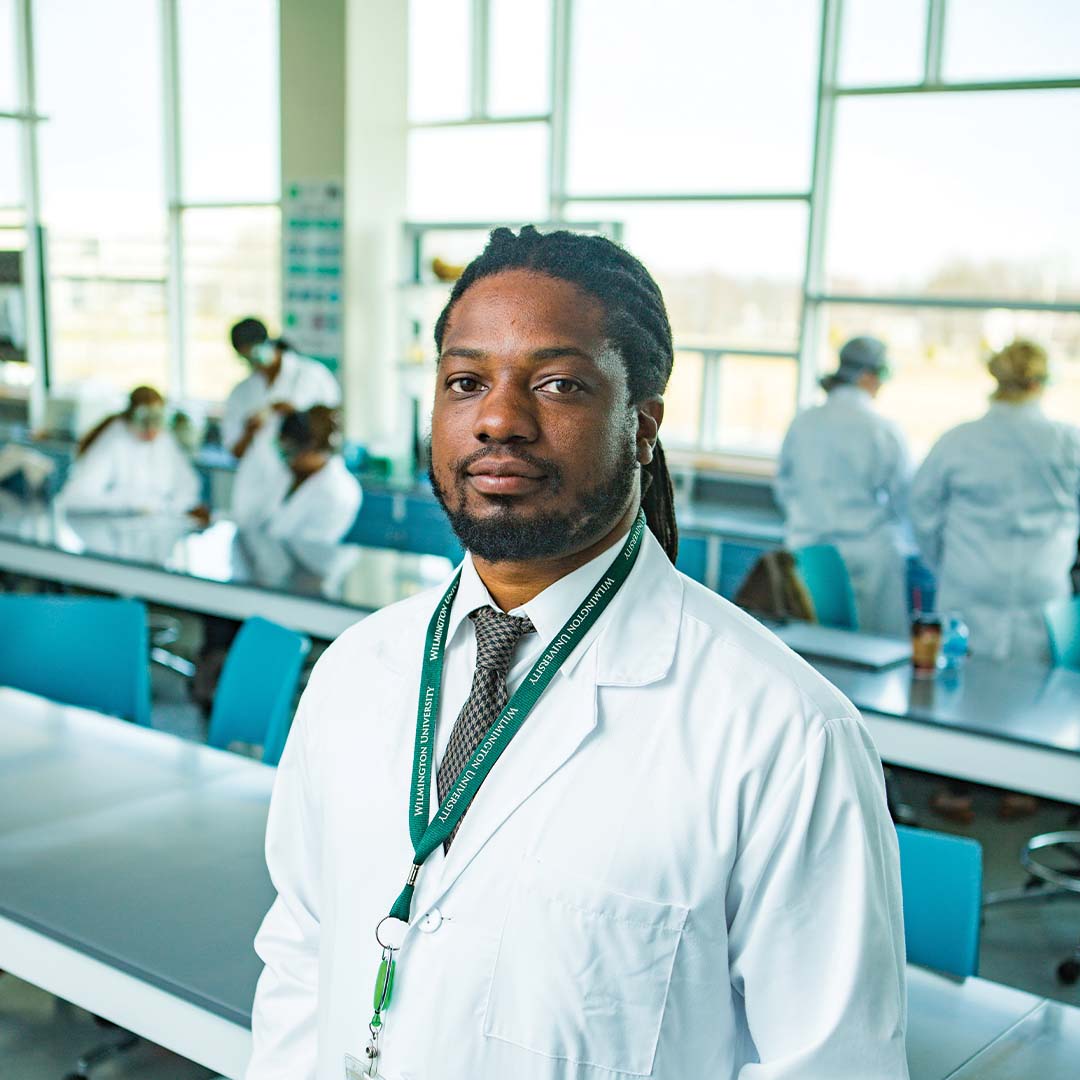
Dr. Milton Muldrow, dean of Wilmington University’s new College of Sciences and Engineering, is leading the College’s interdisciplinary approach to preparing students for careers in science, technology, and innovation.
The launch of Wilmington University’s new College of Sciences and Engineering marks more than academic reorganization. It’s a reflection of where higher education—and the economy—is heading.
“This is about creating a clearer academic home for students,” says Dr. Milton Muldrow, who was named dean of the new college after serving as chair of Science, Biology and Environmental Science and Policy. “Science, mathematics, computer science, and engineering work best when they’re not operating in silos. The integration helps students see how what they’re learning connects to real-world problems.”
Planning for the college has been underway for several years, driven by University leadership’s recognition that STEM disciplines are central to workforce development, research, and global competitiveness.
A decade ago, when Dr. Muldrow arrived at WilmU, science offerings were limited, and no degrees were offered. Today, students can pursue undergraduate and graduate degrees in fields ranging from biotechnology to chemistry. The new college formalizes that growth, bringing related disciplines under one academic umbrella and establishing science and engineering as a core pillar of the University.
The timing is strategic. Government projections indicate that science and engineering jobs will outpace growth in other sectors through at least 2033, fueled by demand in technology, healthcare, clean energy, and artificial intelligence. Computer-related roles lead the trend, with cybersecurity projected to grow by 33% and software development by 17%. Industrial engineering is expected to grow 12%, while mechanical engineering is projected to grow 11%.
“This is about creating a clearer academic home for students. . . . Science, mathematics, computer science, and engineering work best when they’re not operating in silos.”
— Dr. Milton Muldrow
“If you look at our economy and the convergence of fields, it’s turning very sharply in the STEM direction,” Dr. Muldrow says.
Delaware is well positioned to provide STEM career opportunities. The First State’s long association with the DuPont Co. and the biopharmaceutical industry established a deep scientific footprint, while a robust banking and finance sector has driven sustained demand for computer science and data analytics expertise. The new college is designed to meet regional, national and international workforce needs.
“The College of Sciences and Engineering reflects a clear understanding of today’s workforce realities and where opportunity is growing,” says Senior Vice President and Chief Academic Officer Dr. Denise Wells. “Delaware’s strength in life sciences, clean energy, technology, and data-driven fields calls for interdisciplinary preparation, and this College is designed to meet that demand — regionally and beyond.”
Artificial intelligence, Dr. Muldrow adds, is accelerating—not diminishing—opportunity for STEM professionals. “There are a lot of headlines about AI dinging opportunities in the sciences,” he says. “But it’s not replacing humans in the innovation pipeline, particularly in biology; it is augmenting and speeding it up. AI is driving demand for people who understand the science behind the systems, the data, and the ethical and policy implications.”
One of the defining features of the new college is its integrated structure. Students studying Biology, Chemistry, Engineering, and related fields will encounter coursework that overlaps disciplines and mirrors how problems are solved outside academia.
“That integration prepares students for careers that increasingly demand interdisciplinary skills,” Muldrow says. “In the real world, challenges don’t come labeled as ‘biology’ or ‘computer science.’”
The college also emphasizes hands-on experiential learning. Undergraduate and graduate students engage in research, often one-on-one with faculty or through internships. “The best way to learn about research is to do research,” Dr. Muldrow says.
With the new college comes an expansion of academic pathways. WilmU is introducing new data science programs and graduate degrees in Biology, along with associate degrees in Biology and Chemistry. A pre-med track is also in development, reflecting student interest and workforce demand.
Beyond campus, the college is strengthening outreach efforts by offering courses in high schools and working directly with students—particularly in the City of Wilmington—to build early pathways into STEM fields.
“Delaware’s strength in life sciences, clean energy, technology, and data-driven fields calls for interdisciplinary preparation, and this College is designed to meet that demand — regionally and beyond.”
— Dr. Denise Wells
“I’ve long wanted to do more with high schools, making students who are excited about science aware of opportunities to earn degrees and perform research,” Dr. Muldrow says, pointing to a Howard High School of Technology student who later blossomed at WilmU through the NASA Delaware Space Grant program. That program, where Dr. Muldrow currently serves as associate director, allows students to participate in NASA-supported aeronautics and space research.
Students will benefit from a mix of in-person and virtual learning. WilmU’s Brandywine campus offers state-of-the-art laboratories for in-person science and engineering instruction, while virtual options provide flexibility for working adults.
Dr. Muldrow’s approach to education is rooted in lifelong curiosity about the natural world. Growing up in Baltimore, he gravitated toward science early. “In elementary school, I was always picking up rocks, checking books about dinosaurs out of the library, and learning all I could,” he recalls.
He earned a bachelor’s in Biology from St. Francis University, followed by a National Science Foundation Graduate STEM Fellowship that took him to the University of Missouri–St. Louis, where he completed a master’s in Biology. His thesis focused on tropical forest restoration in the Florida Keys.
Dr. Muldrow also worked as a biologist and program analyst at the National Science Foundation, where he helped write an early report on climate change. His work included recommending funding for undergraduate research experiences, leading NSF-supported marine research projects in Florida, and producing educational materials on climate science.
He later earned a Ph.D. in Environmental Science and Public Policy from George Mason University, where he studied shifting baselines in coral reef conservation, a theme that spans natural science, policy, and long-term societal impact. He is the author of Synthetic Biology: Life’s Extraordinary New Worlds, an audiobook on the emerging field that combines biology and engineering.
Since joining WilmU, Dr. Muldrow has played a central role in expanding the University’s science offerings. As chair, he launched Environmental Science, Chemistry, and Biology programs, helping build a pipeline of graduates entering some of Delaware’s fastest-growing employment sectors. Today, as dean, he is focused on scale and sustainability.
That includes developing internship partnerships, expanding undergraduate and graduate research, and ensuring that programs remain aligned with industry needs. It also supports innovation through curricula and applied research.
“I’ve spoken with students, and they’re very excited by the opportunity to earn degrees and certificates through the new college,” Dr. Muldrow says. “They see where these fields are going, and they want to be part of it.”
“Dr. Muldrow brings a deep understanding of the convergence shaping science, engineering, and mathematics,” says Dr. Wells. “Under his leadership, the College prepares students not just for their first job, but for careers that will continue to evolve with technology, data, and discovery.”
As science and engineering continue to shape the future of work, WilmU is helping students to be career-ready at the center of that transformation.
— Eileen Smith Dallabrida
Dr. Milton Muldrow, dean of Wilmington University’s new College of Sciences and Engineering, is leading the College’s interdisciplinary approach to preparing students for careers in science, technology, and innovation.
The launch of Wilmington University’s new College of Sciences and Engineering marks more than academic reorganization. It’s a reflection of where higher education—and the economy—is heading.
“This is about creating a clearer academic home for students,” says Dr. Milton Muldrow, who was named dean of the new college after serving as chair of Science, Biology and Environmental Science and Policy. “Science, mathematics, computer science, and engineering work best when they’re not operating in silos. The integration helps students see how what they’re learning connects to real-world problems.”
Planning for the college has been underway for several years, driven by University leadership’s recognition that STEM disciplines are central to workforce development, research, and global competitiveness.
A decade ago, when Dr. Muldrow arrived at WilmU, science offerings were limited, and no degrees were offered. Today, students can pursue undergraduate and graduate degrees in fields ranging from biotechnology to chemistry. The new college formalizes that growth, bringing related disciplines under one academic umbrella and establishing science and engineering as a core pillar of the University.
The timing is strategic. Government projections indicate that science and engineering jobs will outpace growth in other sectors through at least 2033, fueled by demand in technology, healthcare, clean energy, and artificial intelligence. Computer-related roles lead the trend, with cybersecurity projected to grow by 33% and software development by 17%. Industrial engineering is expected to grow 12%, while mechanical engineering is projected to grow 11%.
“This is about creating a clearer academic home for students. . . . Science, mathematics, computer science, and engineering work best when they’re not operating in silos.”
— Dr. Milton Muldrow
“If you look at our economy and the convergence of fields, it’s turning very sharply in the STEM direction,” Dr. Muldrow says.
Delaware is well positioned to provide STEM career opportunities. The First State’s long association with the DuPont Co. and the biopharmaceutical industry established a deep scientific footprint, while a robust banking and finance sector has driven sustained demand for computer science and data analytics expertise. The new college is designed to meet regional, national and international workforce needs.
“The College of Sciences and Engineering reflects a clear understanding of today’s workforce realities and where opportunity is growing,” says Senior Vice President and Chief Academic Officer Dr. Denise Wells. “Delaware’s strength in life sciences, clean energy, technology, and data-driven fields calls for interdisciplinary preparation, and this College is designed to meet that demand — regionally and beyond.”
Artificial intelligence, Dr. Muldrow adds, is accelerating—not diminishing—opportunity for STEM professionals. “There are a lot of headlines about AI dinging opportunities in the sciences,” he says. “But it’s not replacing humans in the innovation pipeline, particularly in biology; it is augmenting and speeding it up. AI is driving demand for people who understand the science behind the systems, the data, and the ethical and policy implications.”
One of the defining features of the new college is its integrated structure. Students studying Biology, Chemistry, Engineering, and related fields will encounter coursework that overlaps disciplines and mirrors how problems are solved outside academia.
“That integration prepares students for careers that increasingly demand interdisciplinary skills,” Muldrow says. “In the real world, challenges don’t come labeled as ‘biology’ or ‘computer science.’”
The college also emphasizes hands-on experiential learning. Undergraduate and graduate students engage in research, often one-on-one with faculty or through internships. “The best way to learn about research is to do research,” Dr. Muldrow says.
With the new college comes an expansion of academic pathways. WilmU is introducing new data science programs and graduate degrees in Biology, along with associate degrees in Biology and Chemistry. A pre-med track is also in development, reflecting student interest and workforce demand.
Beyond campus, the college is strengthening outreach efforts by offering courses in high schools and working directly with students—particularly in the City of Wilmington—to build early pathways into STEM fields.
“Delaware’s strength in life sciences, clean energy, technology, and data-driven fields calls for interdisciplinary preparation, and this College is designed to meet that demand — regionally and beyond.”
— Dr. Denise Wells
“I’ve long wanted to do more with high schools, making students who are excited about science aware of opportunities to earn degrees and perform research,” Dr. Muldrow says, pointing to a Howard High School of Technology student who later blossomed at WilmU through the NASA Delaware Space Grant program. That program, where Dr. Muldrow currently serves as associate director, allows students to participate in NASA-supported aeronautics and space research.
Students will benefit from a mix of in-person and virtual learning. WilmU’s Brandywine campus offers state-of-the-art laboratories for in-person science and engineering instruction, while virtual options provide flexibility for working adults.
Dr. Muldrow’s approach to education is rooted in lifelong curiosity about the natural world. Growing up in Baltimore, he gravitated toward science early. “In elementary school, I was always picking up rocks, checking books about dinosaurs out of the library, and learning all I could,” he recalls.
He earned a bachelor’s in Biology from St. Francis University, followed by a National Science Foundation Graduate STEM Fellowship that took him to the University of Missouri–St. Louis, where he completed a master’s in Biology. His thesis focused on tropical forest restoration in the Florida Keys.
Dr. Muldrow also worked as a biologist and program analyst at the National Science Foundation, where he helped write an early report on climate change. His work included recommending funding for undergraduate research experiences, leading NSF-supported marine research projects in Florida, and producing educational materials on climate science.
He later earned a Ph.D. in Environmental Science and Public Policy from George Mason University, where he studied shifting baselines in coral reef conservation, a theme that spans natural science, policy, and long-term societal impact. He is the author of Synthetic Biology: Life’s Extraordinary New Worlds, an audiobook on the emerging field that combines biology and engineering.
Since joining WilmU, Dr. Muldrow has played a central role in expanding the University’s science offerings. As chair, he launched Environmental Science, Chemistry, and Biology programs, helping build a pipeline of graduates entering some of Delaware’s fastest-growing employment sectors. Today, as dean, he is focused on scale and sustainability.
That includes developing internship partnerships, expanding undergraduate and graduate research, and ensuring that programs remain aligned with industry needs. It also supports innovation through curricula and applied research.
“I’ve spoken with students, and they’re very excited by the opportunity to earn degrees and certificates through the new college,” Dr. Muldrow says. “They see where these fields are going, and they want to be part of it.”
“Dr. Muldrow brings a deep understanding of the convergence shaping science, engineering, and mathematics,” says Dr. Wells. “Under his leadership, the College prepares students not just for their first job, but for careers that will continue to evolve with technology, data, and discovery.”
As science and engineering continue to shape the future of work, WilmU is helping students to be career-ready at the center of that transformation.
— Eileen Smith Dallabrida