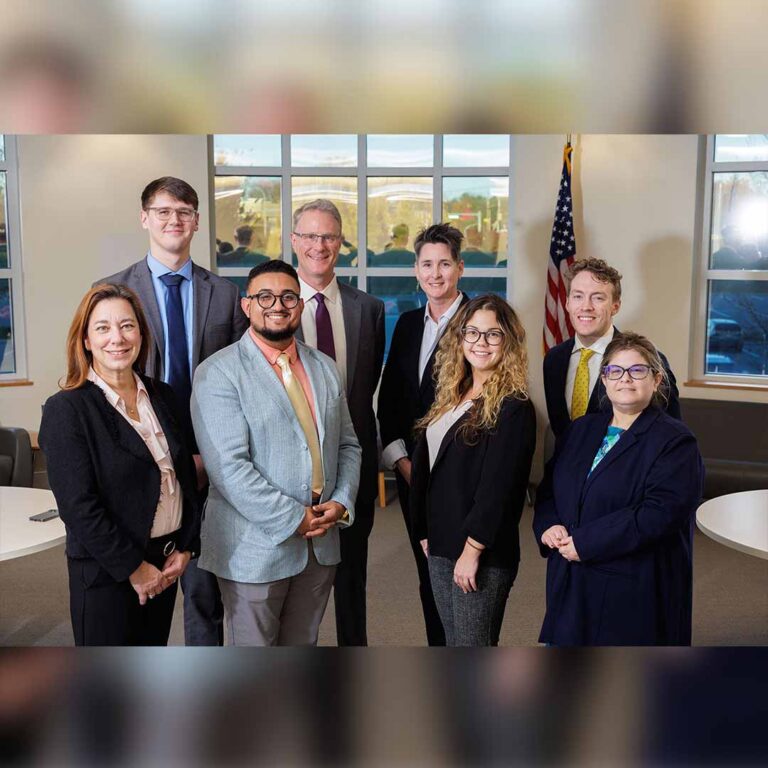
WilmU One-on-One: Attorney and Program Chair Nicole Ballenger Discusses Pursuing a Legal Career

Before joining Wilmington University, Nicole Ballenger, J.D., worked as a paralegal and then an attorney in private practice with an emphasis on civil litigation.
During her time as an educator, she has received outstanding faculty awards and now chairs WilmU’s Law, Policy and Political Science program.
Q. What inspired you to study law and earn your J.D.?
My first professional job after college was working at a law firm. I worked as a paralegal, and during that time, one of my supervising partners encouraged me to apply to law school. Serving as a valued member of a legal team helped to solidify that I enjoyed working in litigation. Receiving motivation from my supervising attorney made law school feel attainable, purposeful and aligned with a profession that I knew would allow me to feel fulfilled for the long term.
Q. Can you tell us about your journey to Wilmington University?
A large part of working in litigation involves teaching. It was my job as an attorney to educate different audiences, including judges, juries, clients and even colleagues, about legal facts and consequences in ways that led to action or decision. Appreciating litigation as teaching practice is what ultimately transitioned me from private practice to higher education. Before becoming a part of the WilmU community, I worked in a similar role as a program director at a law school. The local legal community is close, and maintaining contact with former colleagues is what ultimately brought me to WilmU a little over nine years ago.
Q. The Law, Policy and Political Science degree program is so versatile. Can you share some highlights and how graduates are using this degree to launch careers?
All three concentrations are distinct; however, they share a common intellectual core: decision-making, implementation and interpretation of rules in society. I am incredibly proud of our graduates and all they have accomplished! Graduates have seen success in the legal field, nonprofits, private industry, advocacy, research, education, legislation, compliance, campaigns and are also serving in government roles. Our graduates are our most visible outcome of the University’s mission. Many alums have returned to WilmU to serve on advisory boards, act as guest speakers, instructors and as student mentors.
Q. How is hands-on learning incorporated into the program?
Hands-on learning is at the heart of all three concentrations and is also the mission of the specialized American Bar Association (ABA) approval for the Legal Studies program. Students can research real policy problems, analyze data, engage in simulations, role playing and think-tank exercises. As a part of their classwork, students are encouraged to attend public community meetings to build civic awareness and engage in collective decision-making.
The ABA approval for the Legal Studies concentration, one of only 223 approved programs in the country, requires students to complete legal specialty courses in their curriculum. A legal specialty is defined by the ABA as a course that covers substantive law or legal procedures or processes, has been developed for paralegals, emphasizes practical paralegal skills, and meets the ABA’s instructional requirements. Learning (and life) isn’t always about getting the right answers. Instead, these disciplines gain validity through application, professional judgment and ethical analysis.
Wilmington University creates a shared community of care, responsibility and belonging built around growth, opportunity and learning.
— Nicole Ballenger, J.D.
Wilmington University creates a shared community of care, responsibility and belonging built around growth, opportunity and learning.
— Nicole Ballenger, J.D.
Q. How will WilmU’s new 3+3 Accelerated Law School Pathway benefit your students?
The 3+3 Pathway offers significant academic, financial and professional benefits for motivated and well-advised students. One of the most immediate benefits is saving a full year of study! For students who are confident in their decision to pursue law, the pathway eliminates redundancy without sacrificing academic rigor. The program is a special partnership, directly connecting our undergraduate programs with WilmU Law, where students will receive continued support to succeed in legal practice.
Q. What qualities or skills do you think are especially important for individuals seeking to work within the legal field or the political arena?
Law and politics require the ability to analyze complex information, identify relevant facts and evaluate competing arguments. However, I believe it is the emotional intelligence required in these fields that is most important. Listening, compassion, awareness and the ability to recognize another person’s concerns is paramount. Feeling motivated to respond with care, respect, concern and without judgment is most vital for success in these professions.
Q. What’s something you like to do for fun?
Fun for me involves spending time with family. My college-aged son always ensures that we seek out adventure. Whether we are enjoying time on the beach in North Carolina, exploring the California coast or attending a Formula One race in Montreal, we try to embrace new experiences. We are currently planning our next adventure for this summer, a trip to Germany and Austria.
Q. What do you love about WilmU?
Without a doubt, it is the family atmosphere at WilmU. Two of the many reasons I love my job are the people with whom I work and the students that I have the privilege of serving. Wilmington University creates a shared community of care, responsibility and belonging built around growth, opportunity and learning. There is an innate sense of support, professionalism and inclusion at the University that makes it unique and an amazing place to work.

Learn from dedicated professors like Nicole Ballenger in Wilmington University’s College of Social and Behavioral Sciences.
Before joining Wilmington University, Nicole Ballenger, J.D., worked as a paralegal and then an attorney in private practice with an emphasis on civil litigation.
During her time as an educator, she has received outstanding faculty awards and now chairs WilmU’s Law, Policy and Political Science program.
Q. What inspired you to study law and earn your J.D.?
My first professional job after college was working at a law firm. I worked as a paralegal, and during that time, one of my supervising partners encouraged me to apply to law school. Serving as a valued member of a legal team helped to solidify that I enjoyed working in litigation. Receiving motivation from my supervising attorney made law school feel attainable, purposeful and aligned with a profession that I knew would allow me to feel fulfilled for the long term.
Q. Can you tell us about your journey to Wilmington University?
A large part of working in litigation involves teaching. It was my job as an attorney to educate different audiences, including judges, juries, clients and even colleagues, about legal facts and consequences in ways that led to action or decision. Appreciating litigation as teaching practice is what ultimately transitioned me from private practice to higher education. Before becoming a part of the WilmU community, I worked in a similar role as a program director at a law school. The local legal community is close, and maintaining contact with former colleagues is what ultimately brought me to WilmU a little over nine years ago.
Q. The Law, Policy and Political Science degree program is so versatile. Can you share some highlights and how graduates are using this degree to launch careers?
All three concentrations are distinct; however, they share a common intellectual core: decision-making, implementation and interpretation of rules in society. I am incredibly proud of our graduates and all they have accomplished! Graduates have seen success in the legal field, nonprofits, private industry, advocacy, research, education, legislation, compliance, campaigns and are also serving in government roles. Our graduates are our most visible outcome of the University’s mission. Many alums have returned to WilmU to serve on advisory boards, act as guest speakers, instructors and as student mentors.
Q. How is hands-on learning incorporated into the program?
Hands-on learning is at the heart of all three concentrations and is also the mission of the specialized American Bar Association (ABA) approval for the Legal Studies program. Students can research real policy problems, analyze data, engage in simulations, role playing and think-tank exercises. As a part of their classwork, students are encouraged to attend public community meetings to build civic awareness and engage in collective decision-making.
The ABA approval for the Legal Studies concentration, one of only 223 approved programs in the country, requires students to complete legal specialty courses in their curriculum. A legal specialty is defined by the ABA as a course that covers substantive law or legal procedures or processes, has been developed for paralegals, emphasizes practical paralegal skills, and meets the ABA’s instructional requirements. Learning (and life) isn’t always about getting the right answers. Instead, these disciplines gain validity through application, professional judgment and ethical analysis.
Wilmington University creates a shared community of care, responsibility and belonging built around growth, opportunity and learning.
— Nicole Ballenger, J.D.
Wilmington University creates a shared community of care, responsibility and belonging built around growth, opportunity and learning.
— Nicole Ballenger, J.D.
Q. How will WilmU’s new 3+3 Accelerated Law School Pathway benefit your students?
The 3+3 Pathway offers significant academic, financial and professional benefits for motivated and well-advised students. One of the most immediate benefits is saving a full year of study! For students who are confident in their decision to pursue law, the pathway eliminates redundancy without sacrificing academic rigor. The program is a special partnership, directly connecting our undergraduate programs with WilmU Law, where students will receive continued support to succeed in legal practice.
Q. What qualities or skills do you think are especially important for individuals seeking to work within the legal field or the political arena?
Law and politics require the ability to analyze complex information, identify relevant facts and evaluate competing arguments. However, I believe it is the emotional intelligence required in these fields that is most important. Listening, compassion, awareness and the ability to recognize another person’s concerns is paramount. Feeling motivated to respond with care, respect, concern and without judgment is most vital for success in these professions.
Q. What’s something you like to do for fun?
Fun for me involves spending time with family. My college-aged son always ensures that we seek out adventure. Whether we are enjoying time on the beach in North Carolina, exploring the California coast or attending a Formula One race in Montreal, we try to embrace new experiences. We are currently planning our next adventure for this summer, a trip to Germany and Austria.
Q. What do you love about WilmU?
Without a doubt, it is the family atmosphere at WilmU. Two of the many reasons I love my job are the people with whom I work and the students that I have the privilege of serving. Wilmington University creates a shared community of care, responsibility and belonging built around growth, opportunity and learning. There is an innate sense of support, professionalism and inclusion at the University that makes it unique and an amazing place to work.
Learn from dedicated professors like Nicole Ballenger in Wilmington University’s College of Social and Behavioral Sciences.