
Wilmington University School of Law Hosts Delaware Supreme Court for Live Oral Arguments
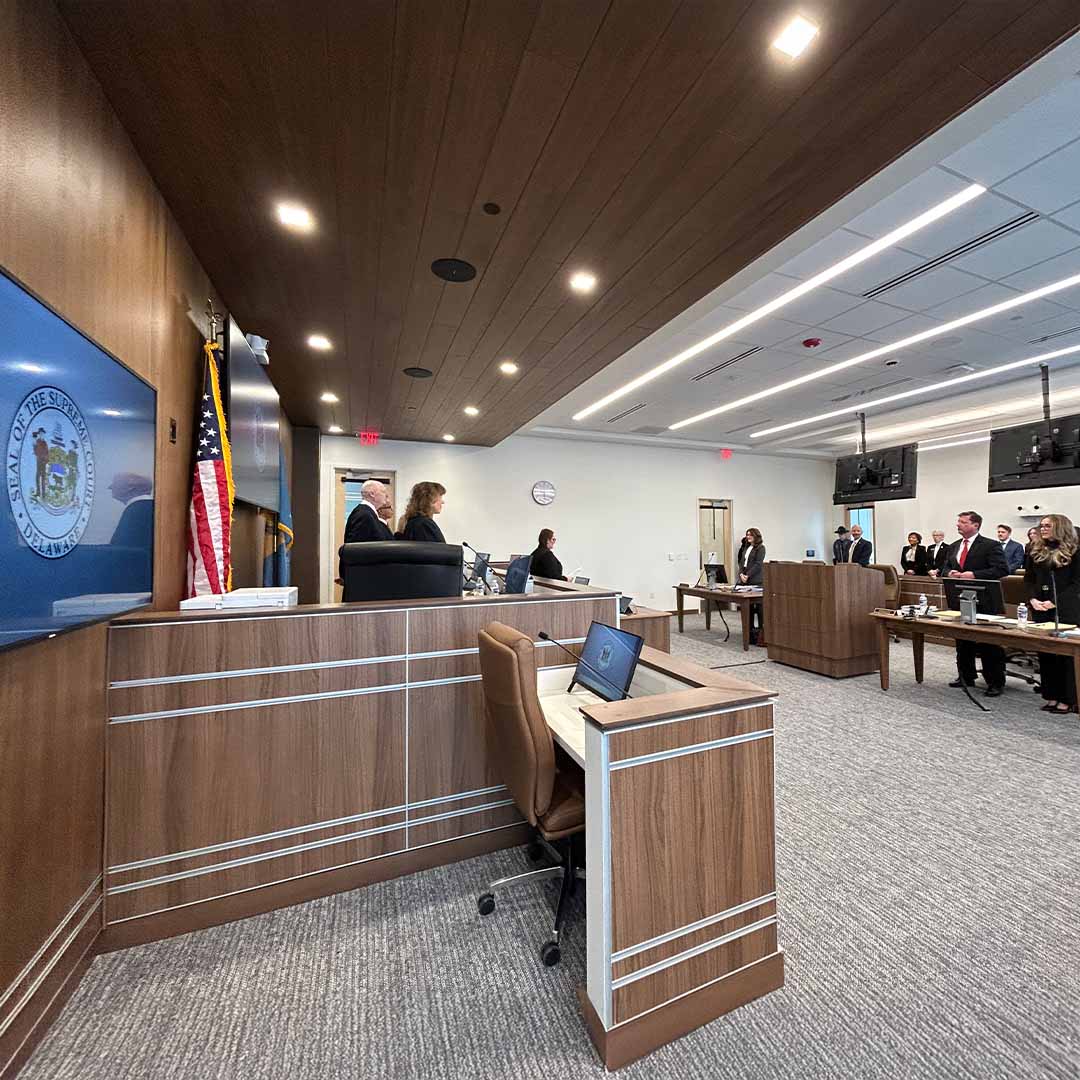
Delaware Supreme Court justices visited Wilmington University School of Law to hear oral arguments in two active cases in its state-of-the-art moot court. Photo Credit: Sean O’Sullivan, Chief of Community Relations, Delaware Judiciary
Wilmington University School of Law recently welcomed the Delaware Supreme Court to its campus in North Wilmington, where students had the rare opportunity to watch oral arguments in two actual cases. The experience offered a direct view of the appellate process as it unfolded in real time, with real litigants, active legal questions, and immediate stakes.
Chief Justice Collins J. Seitz Jr., Justice Karen L. Valihura, and Justice N. Christopher Griffiths visited the School of Law to hear the cases, and students had the opportunity to take part in question-and-answer sessions with the justices and attorneys after each case. Students from Concord High School, The Islamic Academy of Delaware High School, Nativity Preparatory School of Wilmington, and Serviam Girls Academy Middle School joined Wilmington University law students for the visit. Some watched in the state-of-the-art moot courtroom, chosen from a highly competitive lottery, while middle school and high school students viewed a livestream from various on-campus spaces.
The experience gave students a close look at appellate advocacy in practice, highlighting the preparation, precision, and legal reasoning that shape each argument. The justices’ and attorneys’ conversations with students added another layer to the experience, offering insight into the law, the courts, and the legal profession.
“It was a privilege to welcome Chief Justice Seitz, Justice Valihura, and Justice Griffiths to campus, and we are deeply grateful for the time, care, and generosity they offered our students,” says School of Law Dean Jan Jurden. “Their presence on our campus, their willingness to hear actual cases here, and the insight they shared gave our students a rare chance to see the law in practice.”
Dean Jurden’s gratitude for the visit was clear. So was her admiration for the law students. “I was proud of all of them,” she says. “Their questions reflected intellectual curiosity, depth, their academic experiences, and the positive influence of their professors. Most rewarding was the fact that the justices seemed to recognize their level of engagement and responded with compassion and respect.”
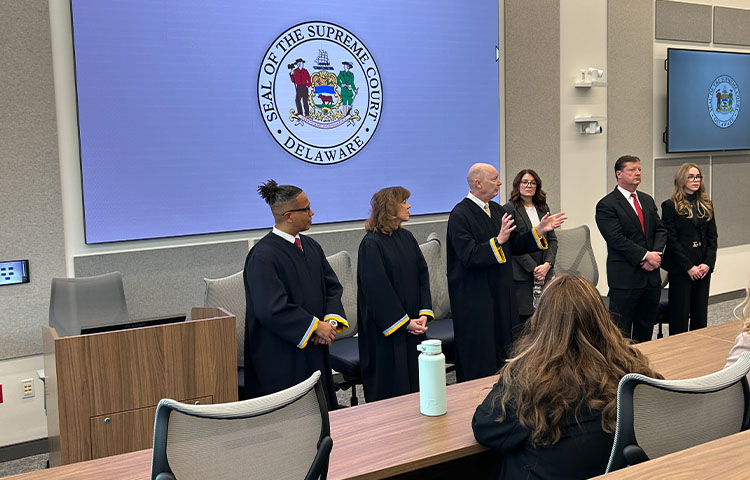
Through the same lottery, 10 law students also had the opportunity to gather in an intimate setting to enjoy lunch with Justices Valihura and Griffiths, Dean Jurden, and Wilmington University President Dr. LaVerne Harmon. Around the table, students posed personal questions and spoke candidly about what they had witnessed. The justices met that openness with candor of their own, reflecting on the challenges young attorneys often face, including stress, difficult colleagues or clients, and the search for purpose in the profession. Drawing on lessons from their early years in the law, they spoke about the importance of collegiality, the discipline of self-care, and the need to make time for family and the people who sustain us.
For WilmU law students Eric Kalet, a full-time 1L, and Madeline Evarts, a part-time 1L, the day offered a firsthand look at appellate advocacy. “Observing oral argument before the Delaware Supreme Court was an exceptional learning experience,” says Kalet. “It reinforced the importance of preparation, precision, and command of the record. Seeing the justices examine issues such as statutory interpretation, standards of review, and precedent brought our classroom discussions to life and showed how legal theory shapes real-world outcomes.”
“I tell my students to write from their hearts, which is just what I did with my book,” she says. “I want to give people hope that they can be crazy in love.”
— Eileen Smith Dallabrida
Evarts agrees. “Watching Delaware Supreme Court oral arguments at Wilmington University School of Law and joining several of the justices for lunch was inspiring and insightful,” she says. “Seeing advocacy at that level and hearing the justices speak candidly about the legal field made the study of law feel immediate and real.”
It’s one thing to study law in the classroom, “and another to see it come alive right on campus,” Evarts adds. “I’m incredibly thankful for opportunities like these that make legal education so dynamic.”
Delaware Supreme Court justices visited Wilmington University School of Law to hear oral arguments in two active cases in its state-of-the-art moot court. Photo Credit: Sean O’Sullivan, Chief of Community Relations, Delaware Judiciary
Wilmington University School of Law recently welcomed the Delaware Supreme Court to its campus in North Wilmington, where students had the rare opportunity to watch oral arguments in two actual cases. The experience offered a direct view of the appellate process as it unfolded in real time, with real litigants, active legal questions, and immediate stakes.
Chief Justice Collins J. Seitz Jr., Justice Karen L. Valihura, and Justice N. Christopher Griffiths visited the School of Law to hear the cases, and students had the opportunity to take part in question-and-answer sessions with the justices and attorneys after each case. Students from Concord High School, The Islamic Academy of Delaware High School, Nativity Preparatory School of Wilmington, and Serviam Girls Academy Middle School joined Wilmington University law students for the visit. Some watched in the state-of-the-art moot courtroom, chosen from a highly competitive lottery, while middle school and high school students viewed a livestream from various on-campus spaces.
The experience gave students a close look at appellate advocacy in practice, highlighting the preparation, precision, and legal reasoning that shape each argument. The justices’ and attorneys’ conversations with students added another layer to the experience, offering insight into the law, the courts, and the legal profession.
“It was a privilege to welcome Chief Justice Seitz, Justice Valihura, and Justice Griffiths to campus, and we are deeply grateful for the time, care, and generosity they offered our students,” says School of Law Dean Jan Jurden. “Their presence on our campus, their willingness to hear actual cases here, and the insight they shared gave our students a rare chance to see the law in practice.”
Dean Jurden’s gratitude for the visit was clear. So was her admiration for the law students. “I was proud of all of them,” she says. “Their questions reflected intellectual curiosity, depth, their academic experiences, and the positive influence of their professors. Most rewarding was the fact that the justices seemed to recognize their level of engagement and responded with compassion and respect.”
Through the same lottery, 10 law students also had the opportunity to gather in an intimate setting to enjoy lunch with Justices Valihura and Griffiths, Dean Jurden, and Wilmington University President Dr. LaVerne Harmon. Around the table, students posed personal questions and spoke candidly about what they had witnessed. The justices met that openness with candor of their own, reflecting on the challenges young attorneys often face, including stress, difficult colleagues or clients, and the search for purpose in the profession. Drawing on lessons from their early years in the law, they spoke about the importance of collegiality, the discipline of self-care, and the need to make time for family and the people who sustain us.
For WilmU law students Eric Kalet, a full-time 1L, and Madeline Evarts, a part-time 1L, the day offered a firsthand look at appellate advocacy. “Observing oral argument before the Delaware Supreme Court was an exceptional learning experience,” says Kalet. “It reinforced the importance of preparation, precision, and command of the record. Seeing the justices examine issues such as statutory interpretation, standards of review, and precedent brought our classroom discussions to life and showed how legal theory shapes real-world outcomes.”
“I tell my students to write from their hearts, which is just what I did with my book,” she says. “I want to give people hope that they can be crazy in love.”
— Eileen Smith Dallabrida
Evarts agrees. “Watching Delaware Supreme Court oral arguments at Wilmington University School of Law and joining several of the justices for lunch was inspiring and insightful,” she says. “Seeing advocacy at that level and hearing the justices speak candidly about the legal field made the study of law feel immediate and real.”
It’s one thing to study law in the classroom, “and another to see it come alive right on campus,” Evarts adds. “I’m incredibly thankful for opportunities like these that make legal education so dynamic.”